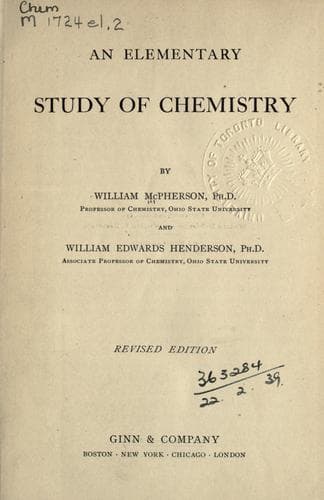
An Elementary Study of ChemistryMcPherson, William
Science
An Elementary Study of Chemistry
McPherson, William
Chemistry
==================================================================
| | | | |
| | | | | FORMULAS OF OXIDES
| SYMBOL | ATOMIC | DENSITY | MELTING |___________________
| | WEIGHT | | POINT | |
| | | | | "ous" | "ic"
________|________|________|_________|_________|__________|________
| | | | | |
Copper | Cu | 63.6 | 8.89 | 1084 deg. | Cu_{2}O | CuO
Mercury | Hg | 200.00 | 13.596 | -39.5 deg. | Hg_{2}O | HgO
Silver | Ag | 107.93 | 10.5 | 960 deg. | Ag_{2}O | AgO
==================================================================
~The family.~ By referring to the periodic arrangement of the elements
(page 168), it will be seen that mercury is not included in the same
family with copper and silver. Since the metallurgy of the three
elements is so similar, however, and since they resemble each other so
closely in chemical properties, it is convenient to class them together
for study.
1. _Occurrence._ The three elements occur in nature to some extent in
the free state, but are usually found as sulphides. Their ores are easy
to reduce.
2. _Properties._ They are heavy metals of high luster and are especially
good conductors of heat and electricity. They are not very active
chemically. Neither hydrochloric nor dilute sulphuric acid has any
appreciable action upon them. Concentrated sulphuric acid attacks all
three, forming metallic sulphates and evolving sulphur dioxide, while
nitric acid, both dilute and concentrated, converts them into nitrates
with the evolution of oxides of nitrogen.
3. _Two series of salts._ Copper and mercury form oxides of the types
M_{2}O and MO, as well as two series of salts. In one series the metals
are univalent and the salts have formulas like those of the sodium
salts. They are called cuprous and mercurous salts. In the other series
the metals are divalent and resemble magnesium salts in formulas. These
are called cupric and mercuric salts. Silver forms only one series of
salts, being always a univalent metal.
COPPER
~Occurrence.~ The element copper has been used for various purposes since
the earliest days of history. It is often found in the metallic state in
nature, large masses of it occurring pure in the Lake Superior region
and in other places to a smaller extent. The most valuable ores are the
following:
Cuprite Cu_{2}O.
Chalcocite Cu_{2}S.
Chalcopyrite CuFeS_{2}.
Bornite Cu_{3}FeS_{3}.
Malachite CuCO_{3}.Cu(OH)_{2}.
Azurite 2CuCO_{3}.Cu(OH)_{2}.
Public-domain text, read in full here on John Shaqi.
Reviews
Reviews
No reviews yet
Be the first to share your thoughts on this work.
Elsewhere in the archive
Join the Discussion
Join the discussion
Sign in to leave a comment or review.
Sign InorCreate an account