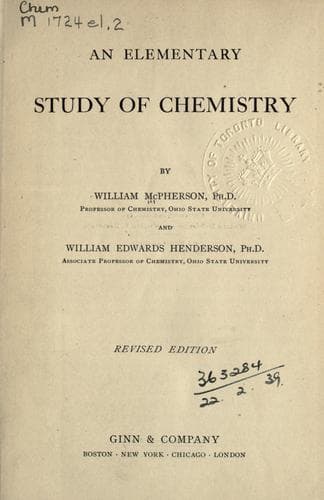
An Elementary Study of ChemistryMcPherson, William
Science
An Elementary Study of Chemistry
McPherson, William
Chemistry
It will be seen that the charge of the iron ions has been diminished
from 3 to 2. Since these changes are the reverse of the oxidation
changes just considered, they are called reduction reactions. The term
"reduction" is applied to all processes in which the valence of the
metal of a compound is diminished, or, in other words, to all processes
in which the charge on the cations is diminished.
NICKEL AND COBALT
These elements occur sparingly in nature, usually combined with arsenic
or with arsenic and sulphur. Both elements have been found in the free
state in meteorites. Like iron they form two series of compounds, but
the salts corresponding to the ferrous salts are the most common, the
ones corresponding to the ferric salts being difficult to obtain. Thus
we have the chlorides NiCl_{2}.6H_{2}O and CoCl_{2}.6H_{2}O; the
sulphates NiSO_{4}.7H_{2}O and CoSO_{4}.7H_{2}O; the nitrates
Ni(NO_{3})_{2}.6H_{2}O and Co(NO_{3})_{2}.6H_{2}O.
Nickel is largely used as an alloy with other metals. Alloyed with
copper it forms coin metal from which five-cent pieces are made, with
copper and zinc it forms German silver, and when added to steel in small
quantities nickel steel is formed which is much superior to common steel
for certain purposes. When deposited by electrolysis upon the surface of
other metals such as iron, it forms a covering which will take a high
polish and protects the metal from rust, nickel not being acted upon by
moist air. Salts of nickel are usually green.
Compounds of cobalt fused with glass give it an intensely blue color. In
powdered form such glass is sometimes used as a pigment called smalt.
Cobalt salts, which contain water of crystallization, are usually cherry
red in color; when dehydrated they become blue.
EXERCISES
1. In the manufacture of cast iron, why is the air heated before being
forced into the furnace?
2. Write the equations showing how each of the following compounds of
iron could be obtained from the metal itself: ferrous chloride, ferrous
hydroxide, ferrous sulphate, ferrous sulphide, ferrous carbonate, ferric
chloride, ferric sulphate, ferric hydroxide.
3. Account for the fact that a solution of sodium carbonate, when added
to a solution of a ferric salt, precipitates an hydroxide and not a
carbonate.
4. Calculate the percentage of iron in each of the common iron ores.
5. One ton of steel prepared by the Bessemer process is found by
analysis to contain 0.2% carbon. What is the minimum weight of carbon
which must be added in order that the steel may be made to take a
temper?
CHAPTER XXVIII
COPPER, MERCURY, AND SILVER
Public-domain text, read in full here on John Shaqi.
Reviews
Reviews
No reviews yet
Be the first to share your thoughts on this work.
Elsewhere in the archive
Join the Discussion
Join the discussion
Sign in to leave a comment or review.
Sign InorCreate an account