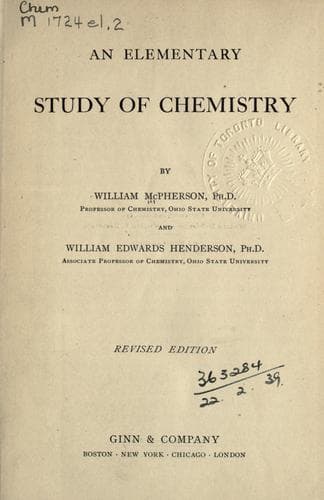
An Elementary Study of ChemistryMcPherson, William
Science
An Elementary Study of Chemistry
McPherson, William
Chemistry
~Cupric hydroxide~ (Cu(OH)_{2}). The hydroxide prepared by treating a
solution of a copper salt with sodium hydroxide is a light blue
insoluble substance which easily loses water and changes into the oxide.
Heat applied to the liquid containing the hydroxide suspended in it
serves to bring about the reaction represented by the equation
Cu(OH)_{2} = CuO + H_{2}O.
~Cupric sulphate~ (_blue vitriol_) (CuSO_{4}.5H_{2}O). This substance,
called blue vitriol or bluestone, is obtained as a by-product in a
number of processes and is produced in very large quantities. It forms
large blue crystals, which lose water when heated and crumble to a white
powder. The salt finds many uses, especially in electrotyping and in
making electrical batteries.
~Cupric sulphide~ (CuS). The insoluble black sulphide (CuS) is easily
prepared by the action of hydrosulphuric acid upon a solution of a
copper salt:
CuSO_{4} + H_{2}S = CuS + H_{2}SO_{4}.
It is insoluble in water and dilute acids.
MERCURY
~Occurrence.~ Mercury occurs in nature chiefly as the sulphide (HgS)
called cinnabar, and in globules of metal inclosed in the cinnabar. The
mercury mines of Spain have long been famous, California being the next
largest producer.
~Metallurgy.~ Mercury is a volatile metal which has but little affinity
for oxygen. Sulphur, on the other hand, readily combines with oxygen.
These facts make the metallurgy of mercury very simple. The crushed ore,
mixed with a small amount of carbon to reduce any oxide or sulphate that
might be formed, is roasted in a current of air. The sulphur burns to
sulphur dioxide, while the mercury is converted into vapor and is
condensed in a series of condensing vessels. The metal is purified by
distillation.
~Properties.~ Mercury is a heavy silvery liquid with a density of 13.596.
It boils at 357 deg. and solidifies at -39.5 deg.. Small quantities of many
metals dissolve in it, forming liquid alloys, while with larger
quantities it forms solid alloys. The alloys of mercury are called
amalgams.
Toward acids mercury conducts itself very much like copper; it is easily
attacked by nitric and hot, concentrated sulphuric acids, while cold
sulphuric and hydrochloric acids have no effect on it.
~Uses.~ Mercury is extensively used in the construction of scientific
instruments, such as the thermometer and barometer, and as a liquid over
which to collect gases which are soluble in water. The readiness with
which it alloys with silver and gold makes it very useful in the
extraction of these elements.
~Compounds of mercury.~ Like copper, mercury forms two series of
compounds: the mercurous, of which mercurous chloride (HgCl) is an
example; and the mercuric, represented by mercuric chloride (HgCl_{2}).
~Mercuric oxide~ (HgO). Mercuric oxide can be obtained either as a
brick-red or as a yellow substance. When mercuric nitrate is heated
carefully the red modification is formed in accordance with the equation
Hg(NO_{3})_{2} = HgO + 2NO_{2} + O.
Public-domain text, read in full here on John Shaqi.
Reviews
Reviews
No reviews yet
Be the first to share your thoughts on this work.
Elsewhere in the archive
Join the Discussion
Join the discussion
Sign in to leave a comment or review.
Sign InorCreate an account