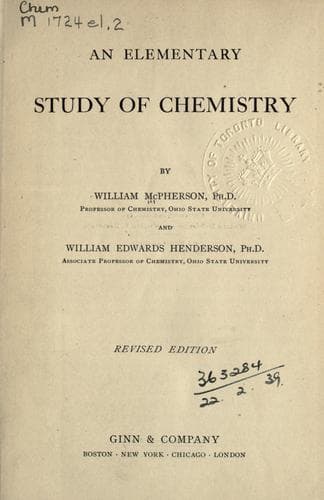
An Elementary Study of ChemistryMcPherson, William
Science
An Elementary Study of Chemistry
McPherson, William
Chemistry
1. From the method of preparation of platinum, what metal is likely to
be alloyed with it?
2. The "platinum chloride" of the laboratory is made by dissolving
platinum in aqua regia. What is the compound?
3. How would you expect potassium aurate and platinate to be formed?
What precautions would this suggest in the use of platinum vessels?
4. Why must gold ores be roasted in the chlorination process?
CHAPTER XXXII
SOME SIMPLE ORGANIC COMPOUNDS
~Division of chemistry into organic and inorganic.~ Chemistry is usually
divided into two great divisions,--organic and inorganic. The original
significance of these terms was entirely different from the meaning
which they have at the present time.
1. _Original significance._ The division into organic and inorganic was
originally made because it was believed that those substances which
constitute the essential parts of living organisms were built up under
the influence of the life force of the organism. Such substances,
therefore, should be regarded as different from those compounds prepared
in the laboratory or formed from the inorganic or mineral constituents
of the earth. In accordance with this view organic chemistry included
those substances formed by living organisms. Inorganic chemistry, on the
other hand, included all substances formed from the mineral portions of
the earth.
In 1828 the German chemist Woehler prepared urea, a typical organic
compound, from inorganic materials. The synthesis of other so-called
organic compounds followed, and at present it is known that the same
chemical laws apply to all substances whether formed in the living
organism or prepared in the laboratory from inorganic constituents. The
terms "organic" and "inorganic" have therefore lost their original
significance.
2. _Present significance._ The great majority of the compounds found in
living organisms contain carbon, and the term "organic chemistry," as
used at present, includes not only these compounds but all compounds of
carbon. _Organic chemistry_ has become, therefore, _the chemistry of the
compounds of carbon_, all other substances being treated under the head
of inorganic chemistry. This separation of the compounds of carbon into
a group by themselves is made almost necessary by their great number,
over one hundred thousand having been recorded. For convenience some of
the simpler carbon compounds, such as the oxides and the carbonates, are
usually discussed in inorganic chemistry.
Public-domain text, read in full here on John Shaqi.
Reviews
Reviews
No reviews yet
Be the first to share your thoughts on this work.
Elsewhere in the archive
Join the Discussion
Join the discussion
Sign in to leave a comment or review.
Sign InorCreate an account