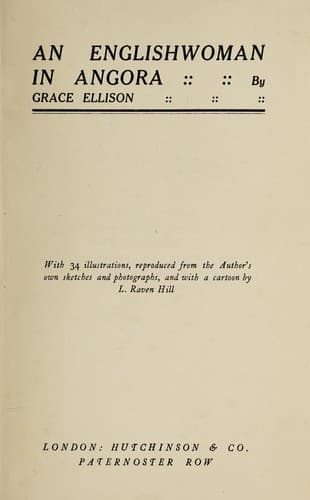
Atatürk, Kemal, 1881-1938; Turkey -- Description and travel; Turkey -- Politics and government -- 1918-1960
Ismet Pasha often worked all night with his hench-men, Colonel Tewfik
and Hikmet Kiamil, a grandson of Kiamil Pasha, who has inherited his
grandfather’s political talents. They felt that the slightest failure to
meet the immense demands made on the delegation would stamp them as an
inferior race, and they determined it should not be.
It was actually after one of their most arduous sittings, up to three
o’clock in the morning, that I obtained from Ismet Pasha the
comprehensive exposition of his point of view, that I have put together
in the following pages.
Ismet Pasha, like Mr. Edison, is deaf; and possibly feels with that
great inventor that, “though it is uncomfortable when people insist on
making a spitoon of your ear, for the rest _it is all advantage_.” For
example, at dinner one can “get on with one’s thinking,” instead of
listening to the conversation. Ismet Pasha only “hears what he wants to
hear,” often a great advantage in diplomacy.
As to being content with the “working of the Conference,” he said, “we
are doing all in our power to make peace, but it is difficult for one
nation against all the other powers. Willingly or unwillingly, they
cannot see what our National Pact means to us; and that, as a proud
people, we cannot accept terms of peace which they would not think of
offering the Greeks and Bulgars. It is said that the Great Powers must
conciliate public opinion which hates and distrusts us as ‘barbarians,’
but we feel certain that the Powers could deal with ‘public opinion’ if
they so desired, and convince the whole world that we are now working by
civilised methods to become a free and independent nation. Instead of
facing the vital question of a ‘right to exist’ as a State, we feel that
much time has been wasted over details that do not need any discussion.
It is known, for example, that we are offering, what we have always
offered, _equal_ rights to Moslems and Christians; yet we are asked to
establish _in_equality by exempting Christians from military service.
“If ever the Powers consent to accept our point of view, it is
considered a great concession, and when we point out that our _whole_
demands have been reduced by us to the lowest minimum, they laugh;
imagining it is a ‘concession’ to give us back _one room_ in our own
house.
“For three years, Turkey has given proof that none can dispute of her
organising capacity, her great vitality, and her deep longing to
regenerate her country. We came here hoping and believing that the
plenipotentiaries would bear this in mind. They do not. They beg us to
‘trust’ them; but they treat us with the same caution, the same
_dis_trust, as they have always shown towards the old ‘decayed’ Turkey,
towards which, maybe, there _used to be_ some slight justification. Such
an attitude cannot produce satisfactory progress.”
“What are the chief obstacles to Peace?”
“Mosul—Finance—Judicial Capitulations—Reparations.
Public-domain text, read in full here on John Shaqi.
Reviews
Reviews
No reviews yet
Be the first to share your thoughts on this work.
Elsewhere in the archive
Join the Discussion
Join the discussion
Sign in to leave a comment or review.
Sign InorCreate an account