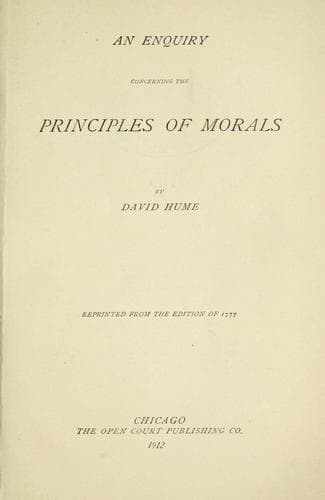
An Enquiry Concerning the Principles of MoralsHume, David
PhilosophyPhilosophy
An Enquiry Concerning the Principles of Morals
Hume, David
Conduct of life; Ethics
This POETICAL fiction of the GOLDEN AGE, is in some respects, of a piece
with the PHILOSOPHICAL fiction of the STATE OF NATURE; only that the
former is represented as the most charming and most peaceable condition,
which can possibly be imagined; whereas the latter is painted out as
a state of mutual war and violence, attended with the most extreme
necessity. On the first origin of mankind, we are told, their ignorance
and savage nature were so prevalent, that they could give no mutual
trust, but must each depend upon himself and his own force or cunning
for protection and security. No law was heard of: No rule of justice
known: No distinction of property regarded: Power was the only measure
of right; and a perpetual war of all against all was the result of men's
untamed selfishness and barbarity.
[Footnote: This fiction of a state of nature, as a state of war,
was not first started by Mr. Hobbes, as is commonly imagined. Plato
endeavours to refute an hypothesis very like it in the second, third,
and fourth books de republica. Cicero, on the contrary, supposes it
certain and universally acknowledged in the following passage. 'Quis
enim vestrum, judices, ignorat, ita naturam rerum tulisse, ut quodam
tempore homines, nondum neque naturali neque civili jure descripto,
fusi per agros ac dispersi vagarentur tantumque haberent quantum manu ac
viribus, per caedem ac vulnera, aut eripere aut retinere potuissent?
Qui igitur primi virtute & consilio praestanti extiterunt, ii perspecto
genere humanae docilitatis atque ingenii, dissipatos unum in locum
congregarunt, eosque ex feritate illa ad justitiam ac mansuetudinem
transduxerunt. Tum res ad communem utilitatem, quas publicas appellamus,
tum conventicula hominum, quae postea civitates nominatae sunt, tum
domicilia conjuncta, quas urbes dicamus, invento & divino & humano jure
moenibus sepserunt. Atque inter hanc vitam, perpolitam humanitate, &
llam immanem, nihil tam interest quam JUS atque VIS. Horum utro uti
nolimus, altero est utendum. Vim volumus extingui. Jus valeat necesse
est, idi est, judicia, quibus omne jus continetur. Judicia displicent,
ant nulla sunt. Vis dominetur necesse est. Haec vident omnes.' Pro Sext.
sec. 42.]
Whether such a condition of human nature could ever exist, or if it
did, could continue so long as to merit the appellation of a STATE,
may justly be doubted. Men are necessarily born in a family-society, at
least; and are trained up by their parents to some rule of conduct and
behaviour. But this must be admitted, that, if such a state of mutual
war and violence was ever real, the suspension of all laws of
justice, from their absolute inutility, is a necessary and infallible
consequence.
The more we vary our views of human life, and the newer and more unusual
the lights are in which we survey it, the more shall we be convinced,
that the origin here assigned for the virtue of justice is real and
satisfactory.
Public-domain text, read in full here on John Shaqi.
Reviews
Reviews
No reviews yet
Be the first to share your thoughts on this work.
Join the Discussion
Join the discussion
Sign in to leave a comment or review.
Sign InorCreate an account