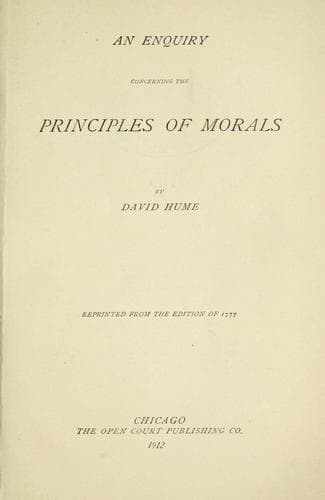
An Enquiry Concerning the Principles of MoralsHume, David
PhilosophyPhilosophy
An Enquiry Concerning the Principles of Morals
Hume, David
Conduct of life; Ethics
It is a doctrine of the Church of Rome, that the priest, by a secret
direction of his intention, can invalidate any sacrament. This position
is derived from a strict and regular prosecution of the obvious truth,
that empty words alone, without any meaning or intention in the speaker,
can never be attended with any effect. If the same conclusion be not
admitted in reasonings concerning civil contracts, where the affair is
allowed to be of so much less consequence than the eternal salvation
of thousands, it proceeds entirely from men's sense of the danger and
inconvenience of the doctrine in the former case: And we may
thence observe, that however positive, arrogant, and dogmatical any
superstition may appear, it never can convey any thorough persuasion
of the reality of its objects, or put them, in any degree, on a balance
with the common incidents of life, which we learn from daily observation
and experimental reasoning.]
These reflections are far from weakening the obligations of justice, or
diminishing anything from the most sacred attention to property. On
the contrary, such sentiments must acquire new force from the present
reasoning. For what stronger foundation can be desired or conceived for
any duty, than to observe, that human society, or even human nature,
could not subsist without the establishment of it; and will still arrive
at greater degrees of happiness and perfection, the more inviolable the
regard is, which is paid to that duty?
The dilemma seems obvious: As justice evidently tends to promote public
utility and to support civil society, the sentiment of justice is either
derived from our reflecting on that tendency, or like hunger, thirst,
and other appetites, resentment, love of life, attachment to offspring,
and other passions, arises from a simple original instinct in the human
breast, which nature has implanted for like salutary purposes. If the
latter be the case, it follows, that property, which is the object of
justice, is also distinguished by a simple original instinct, and is not
ascertained by any argument or reflection. But who is there that ever
heard of such an instinct? Or is this a subject in which new discoveries
can be made? We may as well expect to discover, in the body, new senses,
which had before escaped the observation of all mankind.
But farther, though it seems a very simple proposition to say, that
nature, by an instinctive sentiment, distinguishes property, yet in
reality we shall find, that there are required for that purpose ten
thousand different instincts, and these employed about objects of the
greatest intricacy and nicest discernment. For when a definition of
PROPERTY is required, that relation is found to resolve itself into
any possession acquired by occupation, by industry, by prescription, by
inheritance, by contract, &c. Can we think that nature, by an original
instinct, instructs us in all these methods of acquisition?
Public-domain text, read in full here on John Shaqi.
Reviews
Reviews
No reviews yet
Be the first to share your thoughts on this work.
Join the Discussion
Join the discussion
Sign in to leave a comment or review.
Sign InorCreate an account