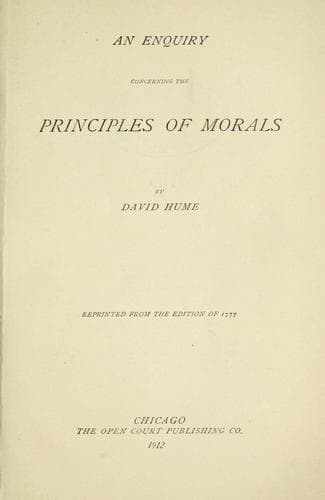
An Enquiry Concerning the Principles of MoralsHume, David
PhilosophyPhilosophy
An Enquiry Concerning the Principles of Morals
Hume, David
Conduct of life; Ethics
The perusal of a history seems a calm entertainment; but would be
no entertainment at all, did not our hearts beat with correspondent
movements to those which are described by the historian.
Thucydides and Guicciardin support with difficulty our attention; while
the former describes the trivial encounters of the small cities of
Greece, and the latter the harmless wars of Pisa. The few persons
interested and the small interest fill not the imagination, and engage
not the affections. The deep distress of the numerous Athenian army
before Syracuse; the danger which so nearly threatens Venice; these
excite compassion; these move terror and anxiety.
The indifferent, uninteresting style of Suetonius, equally with the
masterly pencil of Tacitus, may convince us of the cruel depravity of
Nero or Tiberius: But what a difference of sentiment! While the former
coldly relates the facts; and the latter sets before our eyes the
venerable figures of a Soranus and a Thrasea, intrepid in their fate,
and only moved by the melting sorrows of their friends and kindred. What
sympathy then touches every human heart! What indignation against the
tyrant, whose causeless fear or unprovoked malice gave rise to such
detestable barbarity!
If we bring these subjects nearer: If we remove all suspicion of fiction
and deceit: What powerful concern is excited, and how much superior,
in many instances, to the narrow attachments of self-love and private
interest! Popular sedition, party zeal, a devoted obedience to factious
leaders; these are some of the most visible, though less laudable
effects of this social sympathy in human nature.
The frivolousness of the subject too, we may observe, is not able to
detach us entirely from what carries an image of human sentiment and
affection.
When a person stutters, and pronounces with difficulty, we even
sympathize with this trivial uneasiness, and suffer for him. And it is a
rule in criticism, that every combination of syllables or letters, which
gives pain to the organs of speech in the recital, appears also from a
species of sympathy harsh and disagreeable to the ear. Nay, when we
run over a book with our eye, we are sensible of such unharmonious
composition; because we still imagine, that a person recites it to us,
and suffers from the pronunciation of these jarring sounds. So delicate
is our sympathy!
Easy and unconstrained postures and motions are always beautiful: An
air of health and vigour is agreeable: Clothes which warm, without
burthening the body; which cover, without imprisoning the limbs, are
well-fashioned. In every judgement of beauty, the feelings of the person
affected enter into consideration, and communicate to the spectator
similar touches of pain or pleasure.
Public-domain text, read in full here on John Shaqi.
Reviews
Reviews
No reviews yet
Be the first to share your thoughts on this work.
Join the Discussion
Join the discussion
Sign in to leave a comment or review.
Sign InorCreate an account