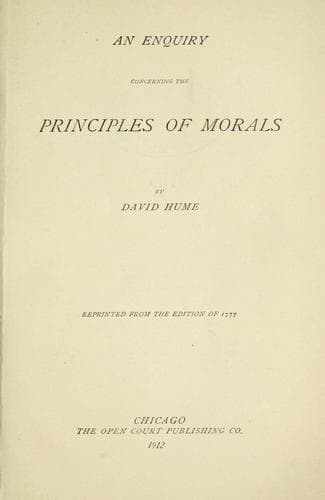
An Enquiry Concerning the Principles of MoralsHume, David
PhilosophyPhilosophy
An Enquiry Concerning the Principles of Morals
Hume, David
Conduct of life; Ethics
If any man from a cold insensibility, or narrow selfishness of temper,
is unaffected with the images of human happiness or misery, he must be
equally indifferent to the images of vice and virtue: As, on the other
hand, it is always found, that a warm concern for the interests of our
species is attended with a delicate feeling of all moral distinctions;
a strong resentment of injury done to men; a lively approbation of their
welfare. In this particular, though great superiority is observable
of one man above another; yet none are so entirely indifferent to the
interest of their fellow-creatures, as to perceive no distinctions
of moral good and evil, in consequence of the different tendencies of
actions and principles. How, indeed, can we suppose it possible in any
one, who wears a human heart, that if there be subjected to his censure,
one character or system of conduct, which is beneficial, and another
which is pernicious to his species or community, he will not so much
as give a cool preference to the former, or ascribe to it the smallest
merit or regard? Let us suppose such a person ever so selfish; let
private interest have ingrossed ever so much his attention; yet in
instances, where that is not concerned, he must unavoidably feel SOME
propensity to the good of mankind, and make it an object of choice, if
everything else be equal. Would any man, who is walking along, tread as
willingly on another's gouty toes, whom he has no quarrel with, as on
the hard flint and pavement? There is here surely a difference in the
case. We surely take into consideration the happiness and misery of
others, in weighing the several motives of action, and incline to the
former, where no private regards draw us to seek our own promotion or
advantage by the injury of our fellow-creatures. And if the principles
of humanity are capable, in many instances, of influencing our actions,
they must, at all times, have some authority over our sentiments, and
give us a general approbation of what is useful to society, and blame of
what is dangerous or pernicious. The degrees of these sentiments may
be the subject of controversy; but the reality of their existence, one
should think, must be admitted in every theory or system.
Public-domain text, read in full here on John Shaqi.
Reviews
Reviews
No reviews yet
Be the first to share your thoughts on this work.
Join the Discussion
Join the discussion
Sign in to leave a comment or review.
Sign InorCreate an account