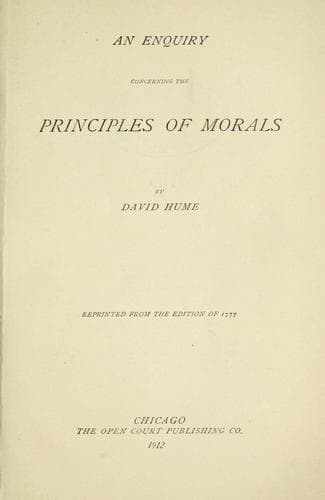
An Enquiry Concerning the Principles of MoralsHume, David
PhilosophyPhilosophy
An Enquiry Concerning the Principles of Morals
Hume, David
Conduct of life; Ethics
Not only such men, as Caesar adds, are commonly DANGEROUS, but also,
having little enjoyment within themselves, they can never become
agreeable to others, or contribute to social entertainment. In all
polite nations and ages, a relish for pleasure, if accompanied with
temperance and decency, is esteemed a considerable merit, even in the
greatest men; and becomes still more requisite in those of inferior rank
and character. It is an agreeable representation, which a French writer
gives of the situation of his own mind in this particular, VIRTUE I
LOVE, says he, WITHOUT AUSTERITY: PLEASURE WITHOUT EFFEMINACY: AND LIFE,
WITHOUT FEARING ITS END. [Footnote: 'J'aime la vertu, sans rudesse;
J'aime le plaisir, sans molesse; J'aime la vie, et n'en crains point la
fin.'-ST. EVREMONT.]
Who is not struck with any signal instance of greatness of mind or
dignity of character; with elevation of sentiment, disdain of slavery,
and with that noble pride and spirit, which arises from conscious
virtue? The sublime, says Longinus, is often nothing but the echo or
image of magnanimity; and where this quality appears in any one,
even though a syllable be not uttered, it excites our applause and
admiration; as may be observed of the famous silence of Ajax in the
Odyssey, which expresses more noble disdain and resolute indignation
than any language can convey [Footnote: Cap. 9.].
WERE I Alexander, said Parmenio, I WOULD ACCEPT OF THESE OFFERS MADE BY
DARIUS. SO WOULD I TOO, replied Alexander, WERE I PARMENIO. This saying
is admirable, says Longinus, from a like principle. [Footnote: Idem.]
GO! cries the same hero to his soldiers, when they refused to follow
him to the Indies, GO TELL YOUR COUNTRYMEN, THAT YOU LEFT Alexander
COMPLETING THE CONQUEST OF THE WORLD. 'Alexander,' said the Prince of
Conde, who always admired this passage, 'abandoned by his soldiers,
among barbarians, not yet fully subdued, felt in himself such a dignity
and right of empire, that he could not believe it possible that any one
would refuse to obey him. Whether in Europe or in Asia, among Greeks or
Persians, all was indifferent to him: wherever he found men, he fancied
he should find subjects.'
The confident of Medea in the tragedy recommends caution and submission;
and enumerating all the distresses of that unfortunate heroine, asks
her, what she has to support her against her numerous and implacable
enemies. MYSELF, replies she; MYSELF I SAY, AND IT IS ENOUGH. Boileau
justly recommends this passage as an instance of true sublime [Footnote:
Reflexion 10 sur Longin.].
When Phocion, the modest, the gentle Phocion, was led to execution, he
turned to one of his fellow-sufferers, who was lamenting his own
hard fate, IS IT NOT GLORY ENOUGH FOR YOU, says he, THAT YOU DIE WITH
PHOCION? [Footnote: Plutarch in Phoc.]
Public-domain text, read in full here on John Shaqi.
Reviews
Reviews
No reviews yet
Be the first to share your thoughts on this work.
Elsewhere in the archive
Join the Discussion
Join the discussion
Sign in to leave a comment or review.
Sign InorCreate an account