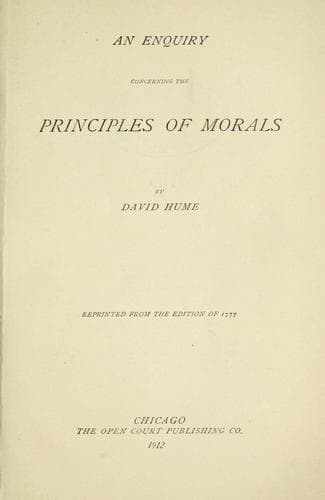
An Enquiry Concerning the Principles of MoralsHume, David
PhilosophyPhilosophy
An Enquiry Concerning the Principles of Morals
Hume, David
Conduct of life; Ethics
Place in opposition the picture which Tacitus draws of Vitellius, fallen
from empire, prolonging his ignominy from a wretched love of life,
delivered over to the merciless rabble; tossed, buffeted, and kicked
about; constrained, by their holding a poniard under his chin, to raise
his head, and expose himself to every contumely. What abject infamy!
What low humiliation! Yet even here, says the historian, he discovered
some symptoms of a mind not wholly degenerate. To a tribune, who
insulted him, he replied, I AM STILL YOUR EMPEROR.
[Footnote: Tacit. hist. lib. iii. The author entering upon the
narration, says, LANIATA VESTE, FOEDUM SPECACULUM DUCEBATUR, MULTIS
INCREPANTIBUS, NULLO INLACRIMANTE: deformatitas exitus misericordiam
abstulerat. To enter thoroughly into this method of thinking, we must
make allowance for the ancient maxims, that no one ought to prolong his
life after it became dishonourable; but, as he had always a right to
dispose of it, it then became a duty to part with it.]
We never excuse the absolute want of spirit and dignity of character, or
a proper sense of what is due to one's self, in society and the common
intercourse of life. This vice constitutes what we properly call
MEANNESS; when a man can submit to the basest slavery, in order to
gain his ends; fawn upon those who abuse him; and degrade himself by
intimacies and familiarities with undeserving inferiors. A certain
degree of generous pride or self-value is so requisite, that the absence
of it in the mind displeases, after the same manner as the want of a
nose, eye, or any of the most material feature of the face or member of
the body.
[Footnote: The absence of virtue may often be a vice; and that of
the highest kind; as in the instance of ingratitude, as well as
meanness. Where we expect a beauty, the disappointment gives an uneasy
sensation, and produces a real deformity. An abjectness of character,
likewise, is disgustful and contemptible in another view. Where a man
has no sense of value in himself, we are not likely to have any higher
esteem of him. And if the same person, who crouches to his superiors,
is insolent to his inferiors (as often happens), this contrariety
of behaviour, instead of correcting the former vice, aggravates it
extremely by the addition of a vice still more odious. See Sect. VIII.]
The utility of courage, both to the public and to the person possessed
of it, is an obvious foundation of merit. But to any one who duly
considers of the matter, it will appear that this quality has a peculiar
lustre, which it derives wholly from itself, and from that noble
elevation inseparable from it. Its figure, drawn by painters and by
poets, displays, in each feature, a sublimity and daring confidence;
which catches the eye, engages the affections, and diffuses, by
sympathy, a like sublimity of sentiment over every spectator.
Public-domain text, read in full here on John Shaqi.
Reviews
Reviews
No reviews yet
Be the first to share your thoughts on this work.
Elsewhere in the archive
Join the Discussion
Join the discussion
Sign in to leave a comment or review.
Sign InorCreate an account