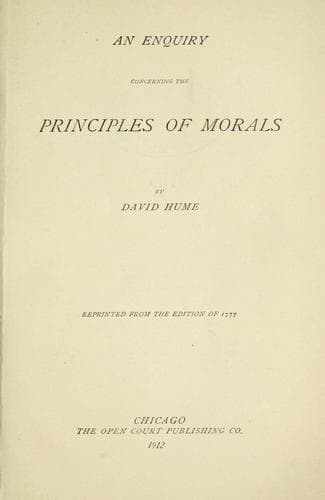
An Enquiry Concerning the Principles of MoralsHume, David
PhilosophyPhilosophy
An Enquiry Concerning the Principles of Morals
Hume, David
Conduct of life; Ethics
[Footnote from Spencer: It is a common use, says he, amongst
their gentlemen's sons, that, as soon as they are able to use their
weapons, they strait gather to themselves three or four stragglers or
kern, with whom wandering a while up and down idly the country, taking
only meat, he at last falleth into some bad occasion, that shall be
offered; which being once made known, he is thenceforth counted a man of
worth, in whom there is courage.]
Of the same class of virtues with courage is that undisturbed
philosophical tranquillity, superior to pain, sorrow, anxiety, and
each assault of adverse fortune. Conscious of his own virtue, say the
philosophers, the sage elevates himself above every accident of life;
and securely placed in the temple of wisdom, looks down on inferior
mortals engaged in pursuit of honours, riches, reputation, and every
frivolous enjoyment. These pretentious, no doubt, when stretched to
the utmost, are by far too magnificent for human nature. They carry,
however, a grandeur with them, which seizes the spectator, and strikes
him with admiration. And the nearer we can approach in practice to this
sublime tranquillity and indifference (for we must distinguish it from a
stupid insensibility), the more secure enjoyment shall we attain within
ourselves, and the more greatness of mind shall we discover to the
world. The philosophical tranquillity may, indeed, be considered only as
a branch of magnanimity.
Who admires not Socrates; his perpetual serenity and contentment, amidst
the greatest poverty and domestic vexations; his resolute contempt of
riches, and his magnanimous care of preserving liberty, while he refused
all assistance from his friends and disciples, and avoided even the
dependence of an obligation? Epictetus had not so much as a door to his
little house or hovel; and therefore, soon lost his iron lamp, the only
furniture which he had worth taking. But resolving to disappoint all
robbers for the future, he supplied its place with an earthen lamp, of
which he very peacefully kept possession ever after.
Among the ancients, the heroes in philosophy, as well as those in war
and patriotism, have a grandeur and force of sentiment, which
astonishes our narrow souls, and is rashly rejected as extravagant and
supernatural. They, in their turn, I allow, would have had equal
reason to consider as romantic and incredible, the degree of humanity,
clemency, order, tranquillity, and other social virtues, to which, in
the administration of government, we have attained in modern times, had
any one been then able to have made a fair representation of them. Such
is the compensation, which nature, or rather education, has made in the
distribution of excellencies and virtues, in those different ages.
Public-domain text, read in full here on John Shaqi.
Reviews
Reviews
No reviews yet
Be the first to share your thoughts on this work.
Elsewhere in the archive
Join the Discussion
Join the discussion
Sign in to leave a comment or review.
Sign InorCreate an account