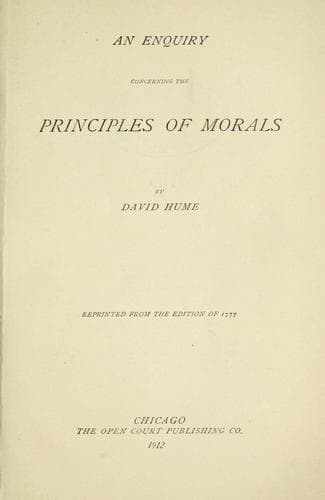
An Enquiry Concerning the Principles of MoralsHume, David
PhilosophyPhilosophy
An Enquiry Concerning the Principles of Morals
Hume, David
Conduct of life; Ethics
The merit of benevolence, arising from its utility, and its tendency
to promote the good of mankind has been already explained, and is, no
doubt, the source of a CONSIDERABLE part of that esteem, which is so
universally paid to it. But it will also be allowed, that the very
softness and tenderness of the sentiment, its engaging endearments, its
fond expressions, its delicate attentions, and all that flow of mutual
confidence and regard, which enters into a warm attachment of love
and friendship: it will be allowed, I say, that these feelings,
being delightful in themselves, are necessarily communicated to the
spectators, and melt them into the same fondness and delicacy. The tear
naturally starts in our eye on the apprehension of a warm sentiment of
this nature: our breast heaves, our heart is agitated, and every humane
tender principle of our frame is set in motion, and gives us the purest
and most satisfactory enjoyment.
When poets form descriptions of Elysian fields, where the blessed
inhabitants stand in no need of each other's assistance, they yet
represent them as maintaining a constant intercourse of love and
friendship, and sooth our fancy with the pleasing image of these soft
and gentle passions. The idea of tender tranquillity in a pastoral
Arcadia is agreeable from a like principle, as has been observed above.
[Footnote: Sect. v. Part 2.]
Who would live amidst perpetual wrangling, and scolding, and mutual
reproaches? The roughness and harshness of these emotions disturb and
displease us: we suffer by contagion and sympathy; nor can we remain
indifferent spectators, even though certain that no pernicious
consequences would ever follow from such angry passions.
As a certain proof that the whole merit of benevolence is not derived
from its usefulness, we may observe, that in a kind way of blame, we
say, a person is TOO GOOD; when he exceeds his part in society, and
carries his attention for others beyond the proper bounds. In
like manner, we say, a man is too HIGH-SPIRITED, TOO INTREPID, TOO
INDIFFERENT ABOUT FORTUNE: reproaches, which really, at bottom, imply
more esteem than many panegyrics. Being accustomed to rate the merit and
demerit of characters chiefly by their useful or pernicious tendencies,
we cannot forbear applying the epithet of blame, when we discover a
sentiment, which rises to a degree, that is hurtful; but it may happen,
at the same time, that its noble elevation, or its engaging tenderness
so seizes the heart, as rather to increase our friendship and concern
for the person.
[Footnote: Cheerfulness could scarce admit of blame from its
excess, were it not that dissolute mirth, without a proper cause or
subject, is a sure symptom and characteristic of folly, and on that
account disgustful.]
Public-domain text, read in full here on John Shaqi.
Reviews
Reviews
No reviews yet
Be the first to share your thoughts on this work.
Elsewhere in the archive
Join the Discussion
Join the discussion
Sign in to leave a comment or review.
Sign InorCreate an account