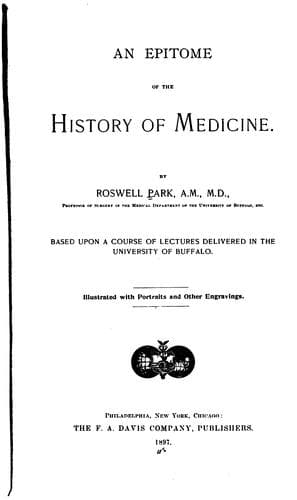
An Epitome of the History of MedicinePark, Roswell
History
An Epitome of the History of Medicine
Park, Roswell
Medicine -- History
Anatomy{188} was now studied more from human bodies, and was authorized
by statute. This was especially the case in non-German institutions, to
which for this reason students flocked in great numbers. In Dresden, so
early as 1617, there was a dissecting-room in which stuffed birds, at
that time a great rarity, and similar curiosities were preserved. The
study of anatomy was at a low ebb in Germany; so that when Rolfink,
in 1629, arranged at Jena, which was then the most popular German
university, for two public dissections upon executed malefactors, it was
considered such an event that the very highest authorities were present.
But the peasantry took such fright at this occurrence that for a long
time afterward they watched their cemeteries by night lest the corpses
should be dug up and, as they said, "Rolfinked." Vienna did not possess
a skeleton until 1658. Strassburg obtained one of a male in 1671, and
several years later one of a female. In Edinburgh an anatomical theatre
was first erected in 1697 in Surgeons' Hall. It is worthy of remark that
anatomical plates, designed to be lifted off in layers, existed even at
this period. About the middle of this century there arose a dispute at
the bedside of the Margrave of Baden, between two learned professors and
the regular court physician, whether a plaster to be applied over the
patient's heart should be placed in the middle of the chest, according
to Galen, or upon the left side. The dispute was settled by opening,
before the eyes of the noble patient, a hog, by means of which it was
demonstrated that, as a matter of fact, the heart of the hog lay on
the left side. So convinced was his excellency that he dismissed the
ordinary physician, who had held a contrary opinion as to the position
of a nobleman's heart.
The general barbarity and immorality of this century were conspicuous,
especially among the upper classes, and by its close had spread from
France, became naturalized in both Germany and Italy, and extended even
to the universities,{189} their professors, and their students. The
life of the latter during this period was more vulgar and rude than ever
before, and almost more so than ever since. Pennalism--that is to say,
barbarity toward junior students--became unbounded, so that outbreaks
occurred even during lectures. At last the State authorities were
compelled to interfere. Student outrages were very frequent and often
fatal, and their outbursts were disgraceful in the extreme.
Public-domain text, read in full here on John Shaqi.
Reviews
Reviews
No reviews yet
Be the first to share your thoughts on this work.
Elsewhere in the archive
Join the Discussion
Join the discussion
Sign in to leave a comment or review.
Sign InorCreate an account