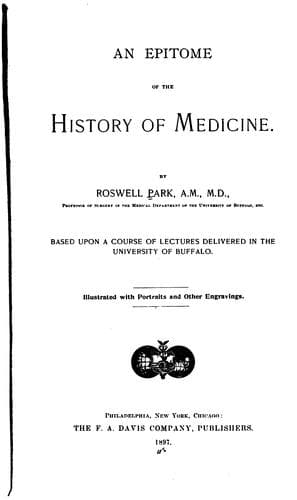
An Epitome of the History of MedicinePark, Roswell
History
An Epitome of the History of Medicine
Park, Roswell
Medicine -- History
Only in France was instruction in surgery well regulated, for this was
the only country which possessed a proper surgical college. Practical
instruction was imparted to mid wives--in Paris through a special
institution, in Germany through the Midwives' Guild; the barbers, too,
continued to receive instruction from their guilds; while instruction in
pharmacy was given by the master-apothe-caries, too often dogmatically
and even farcically, serving as objects for the keen satire of Molière.
The expenses of graduation were very great, and the ceremonies sometimes
lasted two days.
In another way this same seventeenth century might be characterized
as one of aggrandizement for physicians,--that is, as one during
which their position was improved in the eyes of the public and
better supported by the State. The physicians proper--the "_medici
pitri_"--were still persons of the profoundest gravity, with fur-trained
robes, perukes, canes, and swords, when matters were prosperous, who
for their lives would do nothing more than write prescriptions in formal
style, everything else being considered beneath their dignity,--even as
they affect in England to*day. They demanded to be called in every case,
however, even though they knew nothing about it, claiming that only by
means of their presence could things certainly go right. Nevertheless,
in dangerous cases--for example, during the plague--they left the
surgeons alone, while they looked upon the sick through the windows.
In spite of this, however, they were generally esteemed and often{190}
sought for, as well in public as in private. Some of them were supplied
with large libraries by their patrons or through their positions under
the government, and most of them enjoyed moderate prosperity. Their pay
was, for the most part, regulated in accordance with a definite tariff,
while the State gradually cut down the doctor's honorarium to the pay of
a day-laborer. During that century a certain physician to a countess
in Munich received $25 as his annual stipend. For being present at a
post-mortem and rendering an opinion thereon, each physician received
$1.75. Surgeons who were zealous and eager were always highly esteemed;
they were often better educated, in many respects, because of their
extensive travels; but the social emancipation of the surgeons was not
completed until the eighteenth century. About this time amputation of
the arm was supposed to be worth 31 marks ($7.75); of the leg, 41 marks;
or, if a patient died, half this price. Lithotomy cost 51 marks, or
half of that if the patient died. For cataract operation on one eye the
surgeon received 17 marks; for a like operation on both eyes, 25 marks.
Public-domain text, read in full here on John Shaqi.
Reviews
Reviews
No reviews yet
Be the first to share your thoughts on this work.
Elsewhere in the archive
Join the Discussion
Join the discussion
Sign in to leave a comment or review.
Sign InorCreate an account