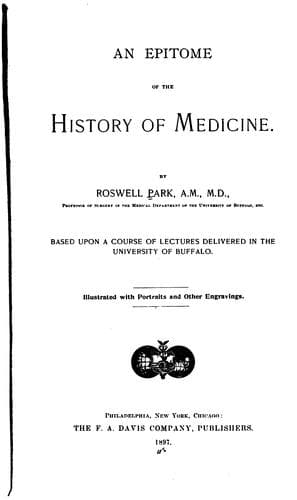
An Epitome of the History of MedicinePark, Roswell
History
An Epitome of the History of Medicine
Park, Roswell
Medicine -- History
The mechanico-dynamic system was a sort of compromise or mixed system,
which was held in high honor by the most eminent physicians and better
minds of the last century, and has even been prized by Sprengel as
the best of all. It was originated by Friedrich Hoffmann (1660-1742).
Hoffmann's father was a physician, and he was himself born in Halle,
whose university he attended. He acquired lasting reputation as an
oculist, and was made Professor of Anatomy, Surgery, Medicine, Physics,
and Chemistry at his _alma mater_. Our commonplace "Hoffmann's anodyne"
is named after him. He was one of the most erudite professors of his
day, more easily understood than Stahl, widely known for his fluent
diction and amiable temper, and, accordingly, won great renown for his
university. His good fortune as a practitioner was so great that even
Boerhaave declared him his own equal. As a writer he was voluminous, one
edition of his works comprising twenty-seven large volumes.
According to Hoffmann's views, life was simply mechanical movement,
especially of the heart; death, the cessation of heart-action,
putrefaction thereupon resulting. Health meant regularity of
movements; disease, a disturbance of the same. He used the word "tonus"
extensively. Ether he regarded as an important factor, producing
and maintaining movements of the body, itself extremely volatile,
corresponding largely to the "pneuma" of the ancients; it was, in fact,
a motor principle and, at the same time, the perceptive soul. Ether was
stored in the medulla, and circulated in a double way in the body; spasm
was the consequence of too strong, atony of too feeble, influx of ether.
Fever was a general spasm of the arteries and veins, having its cause in
the spinal cord. Hoffmann's therapeutics were simple, and poor in drugs.
These latter were intended to weaken, alter, or evacuate, and he{198}
was especially partial to the use of vinous remedies. The strong and
toxic drugs he used but little.
William Cullen (1712-1790), a Scotchman, rose from the deepest poverty
to the greatest celebrity. First a barber, he afterward became an
apothecary, then a ship-surgeon, then a village practitioner, finally
entering into partnership with William Hunter as a general practitioner.
Both of these eminent men being in equally poor circumstances, they
agreed to live in the same place and that, while one was studying, the
other should take care of the practice. In this way Cullen was enabled
to graduate in 1740. Six years later he taught chemistry in Glasgow,
and in ten years more came to Edinburgh as Professor of Medicine. He
continued very active and famous up to the time of his death, but died
as he had been born,--in poverty. Among his numerous other charitable
deeds, he supported the widow of Robert Burns and published the latter's
poems.
Public-domain text, read in full here on John Shaqi.
Reviews
Reviews
No reviews yet
Be the first to share your thoughts on this work.
Elsewhere in the archive
Join the Discussion
Join the discussion
Sign in to leave a comment or review.
Sign InorCreate an account