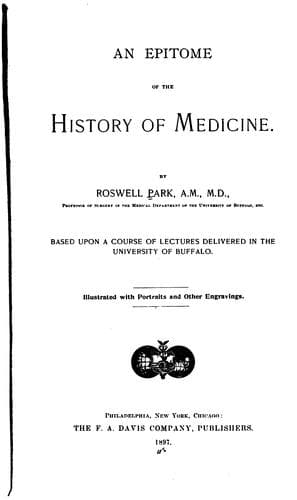
An Epitome of the History of MedicinePark, Roswell
History
An Epitome of the History of Medicine
Park, Roswell
Medicine -- History
Cullen was the father of modern Solidism,--a system based upon the solid
parts of the body, the nerves being the chief agents. The life-giving
element was, in his view, an undefined, dynamic something (different
from Hoffmann's ether or Stahl's soul), which he called _nerve-force, or
nerve-principle; animal force; and brain-energy_, and in it he included
the spinal cord. His nerve-principle was supposed to produce spasms and
atony, either actively or passively. The causes of disease, while of a
debilitating character, were supposed to awaken reaction of the healing
powers of Nature; fever was a reparative effort of Nature, even in
its cold stage, the blood playing no part in it. He constructed a very
arbitrary classification of fevers, as, in fact, he did of all
diseases, his system of nosology being the secret of his reputation. His
explanation of gout was famous. That disorder, he said, depended upon
an atony in the digestive organs against which was periodically set up
a reparative effort in form of a{190} joint inflammation. In scrofula
he had to assume, in contradiction to his nervous pathology, a peculiar
acridity, and in putrid fever a putridity of the humors of the body. His
therapeutics were simple and salutary, because of his renunciation of
venesection, which was much abused in his day.
The most celebrated pupils and successors of Hoffmann were Gregory, of
Edinburgh, Gardiner, and, in Germany, the famous Thaer (1752-1828), who
finally abandoned the practice of medicine because it promised more than
it could perform, and who became a "father of husbandry."
Public-domain text, read in full here on John Shaqi.
Reviews
Reviews
No reviews yet
Be the first to share your thoughts on this work.
Elsewhere in the archive
Join the Discussion
Join the discussion
Sign in to leave a comment or review.
Sign InorCreate an account