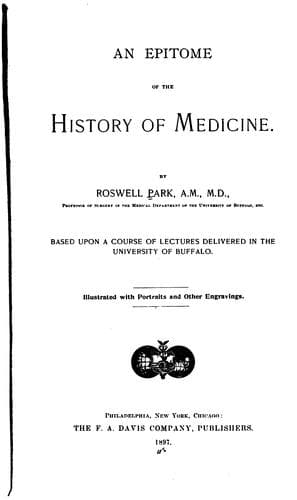
An Epitome of the History of MedicinePark, Roswell
History
An Epitome of the History of Medicine
Park, Roswell
Medicine -- History
It will thus be seen that during the space of about 700 years medicine
underwent a transformation in Greece. It was first domestic and
popular, practiced by shepherds, soldiers,{012} and others; then became
sacerdotal; after the Trojan War it was confined to the vicinity of the
temples and practiced in the name of some divinity; and finally it was
wrapped in mystery and mystic symbolism, where superstition was
played upon and credulity made to pay its reward. Down to the time of
Hippocrates the Asclep-iadæ rendered some genuine service to science,
especially by inculcating habits of observation, in which Hippocrates
excelled above all. Later, however, down to the time of the Christian
era, medicine in the temples declined, and became, in fact, a system
based upon the grossest jugglery.
It is time now that we make a systematic attempt to classify events in
the history of medicine, and to recognize certain distinct epochs as
they have occurred. For this purpose I know of no better arrangement
than that of Renouard, which, in the main, I shall follow, at least
during the forepart of this book. In this sense he divides the past into
three ages, known, respectively, as the _Age of Foundation, the Age
of Transition, and the Age of Renovation_. Each of these chronological
divisions is subdivided into periods, of which the first contains
four:--
AGE OF FOUNDATION.
1. The _Primitive Period_, or that of _Instinct_, beginning with myth,
and ending with the destruction of Troy 1184 years before Christ.
2. The _Sacred, or Mystic, Period_, ending with the dispersion of the
Pythagorean Society, 500 years before Christ.
3. The _Philosophic Period_, terminating with the foundation of the
Alexandrian library, 320 years before Christ.
4. The _Anatomic Period_, ending with the death of Galen, about A.D.
200.
THE SECOND AGE, OR THAT OF TRANSITION, is divided into a fifth, or
_Greek Period_, ending at the burning of the Alexandrian library, A.D.
640, and a sixth, _Arabic Period_, ending with the revival of letters,
A.D. 1400.
THE THIRD AGE, OR THAT OF RENOVATION,{013} includes the seventh, or
_Erudite Period_, comprising the fifteenth and sixteenth centuries, and
eighth, or _Reform Period_, comprising the seventeenth, eighteenth, and
nineteenth centuries.
Public-domain text, read in full here on John Shaqi.
Reviews
Reviews
No reviews yet
Be the first to share your thoughts on this work.
Join the Discussion
Join the discussion
Sign in to leave a comment or review.
Sign InorCreate an account