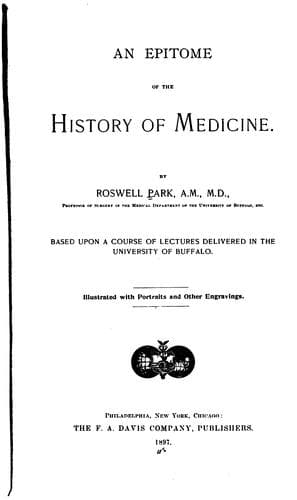
An Epitome of the History of MedicinePark, Roswell
History
An Epitome of the History of Medicine
Park, Roswell
Medicine -- History
Among the French surgeons must be mentioned la Peyronie, of Montpellier,
born in 1668, who ultimately became director of the Academy of Surgery
and surgeon to the king. His wealth was employed for the elevation
of the craft, and he founded no less than ten different surgical
professorships at his own expense. In 1743 he effected the separation of
the surgeons from the barbers. He died in 1747, dedicating his estate
to the purpose for which he had lived. The most famous of the earlier
surgeons of this century was J. L. Petit (16741750), inventor of the
screw tourniquet, and who was called to treat Augustus the Strong,
of Poland; indeed, several other crowned heads became his patients.
Garen-geot (1688-1759), a professor in the College of St. Come,
published a work on operative surgery. Morand (1697-1773) and le Dran
were distinguished surgeons of Paris, the former especially noted for
the number of times{214} he performed paracentesis. Famous lithotomists
were le Cat and Frère Come,--whose real name was Baseilhac, and who
operated by means of the lithotome caché, Astruc (1685-1766) was a
syphilographer of extensive attainments; Quesnay (1694-1774), an eminent
and undaunted surgeon of Louis XV, who wrote on the history and progress
of surgery in France; Brasdor (1721-1776) was best known for his method
of distal ligation in aneurism; Sabatier (1732-1811) wrote a famous
treatise on operations, in which he recommended resection of the head of
the humerus.
One of the most celebrated surgeons was P, J. Desault (1744-1795), the
son of a poor farmer, originally designed for the priesthood, but who,
after obtaining a thorough mathematical education, began the study of
surgery with an ignorant master of his native town. Subsequently he went
to Paris, and here supported himself by teaching, gradually rising, step
by step, until, without collegiate education, he became professor and
chief-surgeon at the Hôtel-Dieu, where he established the first surgical
clinic. He opposed violently the prevalent abuse of the trephine, and
was also a champion of healing by first intention. A trusted friend of
Desault was Ghopart, well known because of the amputation of the foot
that bears his name. Another well-known surgeon, likewise a friend
of Desault, was Doublet; and it is somewhat remarkable that Desault,
Ghopart, and Doublet suffered persecution and perhaps martyrdom in
connection with the supposed death of the Dauphin of France,--properly
Louis XVII,--in 1795. There is evidence that the child who died in the
temple was not the dauphin, but a substitute, and these three surgeons,
who examined the corpse, had the hardihood to express their doubts.
The same day that Desault reported upon the evidence he was invited to
dinner by some members of the Convention, was taken ill at the table,
and died almost immediately after his return home, A few days{215} later
Chopart and Doublet died, also under mysterious circumstances.
Public-domain text, read in full here on John Shaqi.
Reviews
Reviews
No reviews yet
Be the first to share your thoughts on this work.
Elsewhere in the archive
Join the Discussion
Join the discussion
Sign in to leave a comment or review.
Sign InorCreate an account