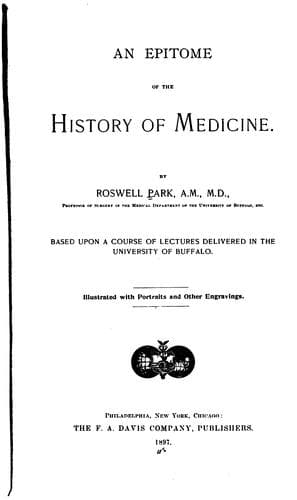
An Epitome of the History of MedicinePark, Roswell
History
An Epitome of the History of Medicine
Park, Roswell
Medicine -- History
Daviel (1796-1862) is remembered among French surgeons chiefly for
extraction of the lens as an independent method of treating cataract;
Tenon (172-4-1816), for his writings on the anatomy and diseases of the
eye; and Anel for originating the operation for aneurism, mistakenly
attributed to Hunter. There were also many others, of lesser note, who
distinguished themselves through special services to surgery or some of
its branches.
Among the Italians of this century may be mentioned Scarpa (1772-1832),
of Motta, professor successively in Modena and Pavia, and who advanced
our knowledge of hernia, diseases of the eyes, aneurism, and general
anatomy.
The most famous Spanish surgeon was Gimbernat, of Madrid (1742-1790),
for a time professor in Barcelona, who also became distinguished through
anatomical researches.
German surgeons did not rank high during the earlier half of the last
century, owing to the contempt engendered by the church for this branch
of the medical art. The fashion of imitating the French, however, led
to some surgical development. The first German surgeon of scientific
education was Heister (1683-1758), of Frankfort-on-the-Main, who,
unable to obtain honorable employment in the military service of his own
country, entered that of Holland, where he remained until the experience
of his own nation had brought about a healthy reaction. In 1720 he came
to Helmstâdt, where he developed great activity in anatomy, surgery,
and botany; also distinguished himself as a dentist and oculist, and
discussed the whole range of surgical topics from the least to the
greatest.
Bilguer (1720-1796), of Chur, became surgeon-general in Berlin, and
performed the first resection of the wrist in 1762;{216} he was an
opponent of amputation, which at that time was altogether too frequently
practiced.
Von Siebold (1736-1807) was the founder of an institution for surgical
instruction, where, for the first time in Germany, surgery was taught
clinically. He became one of the most famous teachers, and was first in
his native land to perform the operation of symphysiotomy, so recently
revived.
The greatest German surgeon of the eighteenth century, however,--one
eminent both as writer and operator,--was August Gottlieb Richter
(1742-1812), of Zorbig, a descendant of a ministerial family, who wrote
a famous work on hernia, and greatly improved all branches of surgery;
he it was that enunciated the principle of dressing wounds "quickly,
easily, and rarely."
Among English surgeons of the century must be mentioned, first of
all, Cheselden (1688-1752). wrhose name is inseparably connected with
anatomy and pathology as well as surgery At first a warm advocate of the
high operation for stone, his dexterity in lithotomy excited the wonder
of his contemporaries. He published a treatise on anatomy, and one on
the suprapubic section.
Public-domain text, read in full here on John Shaqi.
Reviews
Reviews
No reviews yet
Be the first to share your thoughts on this work.
Elsewhere in the archive
Join the Discussion
Join the discussion
Sign in to leave a comment or review.
Sign InorCreate an account