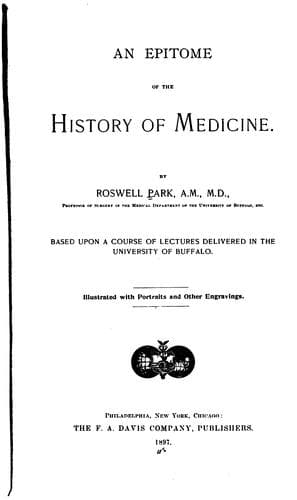
An Epitome of the History of MedicinePark, Roswell
History
An Epitome of the History of Medicine
Park, Roswell
Medicine -- History
Among the Continental students the revels and bad behavior of past
centuries were not to any great extent corrected; fights and debauchery
were very common, and all sorts of orgies and bacchanals prevailed.
The professors were, in large measure, independent of the State, and a
single{233} individual often represented a number of branches now taught
by special chairs. When indisposed to lecture, they simply posted upon
the blackboard: "_Hodie non legitur_," and this was the end of the
matter. In 1777 Vienna had one hundred and forty-seven medical teachers,
and in Germany there were two to every thirty-nine students. That in
the last century one man often accomplished more than a great number
of average teachers do to-day is amply demonstrated by the lives of
Boerhaave, Haller, and others. Then, too, the Latin tongue was generally
employed for purposes of instruction, though surgeons, for the most
part, lectured in the vernacular; Cullen, in 1770, was the first in
Great Britain to deliver purely medical lectures in English; and as the
clergy gradually retired from the ranks of the profession, Latin more
and more fell into disuse. Strange to say, as the clerical influence
waned, the Jews began to enter medicine, the movement beginning about
1791, in France, under the promulgation of "civil equality" ideas;
previously the Hebrews had been an almost universally suppressed people,
and in Berlin were permitted to enter and leave the city by only one
gate, and were forbidden to learn or write pure German, in consequence
whereof their dialect was an Hebraic-Teutonic jargon, that even to-day
prevails in some portions of western Europe. Educated Jews were few in
number, since attendance upon universities was ordinarily denied them,
although long before they had been admitted at Salamanca, Toledo,
Salernum, and Montpellier. In Austria the prohibition was not removed
until 1789, and even then, so bitter was the prejudice against the
Semitic race, the clergy vigorously protested. It was the same clerical
body that, in 1667, protested with the greatest vehemence against
allowing Hebrew physicians to pass through the gates of Wurtemburg
without paying toll, declaring that it was "better to die with Christ
than be cured by Jews, who were aided by the devil."
Professors{234} were often attached to the courts of their various
sovereigns, and at one time the French court possessed a faculty of
forty-eight physicians, surgeons, and apothecaries, the first two
physicians being required to attend every morning when the king arose;
hence originated the titles, still known in Germany, of "Hofrath" and
"Geheimrath."
Public-domain text, read in full here on John Shaqi.
Reviews
Reviews
No reviews yet
Be the first to share your thoughts on this work.
Elsewhere in the archive
Join the Discussion
Join the discussion
Sign in to leave a comment or review.
Sign InorCreate an account