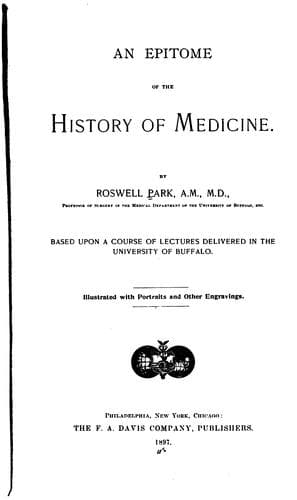
An Epitome of the History of MedicinePark, Roswell
History
An Epitome of the History of Medicine
Park, Roswell
Medicine -- History
Medical fees, as a rule, were very small, though there were exceptional
instances in which enormous sums were bestowed: Joseph II, of Austria,
gave Guerin, who was summoned from Paris in consultation, an honorarium
of 171,000 marks and made him a baronet. Taking all things into
consideration, the income of the average practitioner in the eighteenth
century would be in the neighborhood of $1000, which, however, was
equivalent to three times that amount to-day. Fothergill, whose highest
income in a single year was $25,000, bequeathed to the poor of London
$1,000,000; Sir Astley Cooper had a yearly income of from $75,000 to
$100,000, but it may be remembered that his practice during the first
year netted him just $26, and that it was four years later before his
income reached the sum of $500.
The physician of the last century was, at least, on occasions of moment,
very different from other men, and to be recognized by his dress. A cap
was placed upon his head when he graduated, in recognition of the fact
that physicians at an earlier period belonged to the learned or clerical
profession; and in later life he wore a purplish or scarlet cloak (to
distinguish him from lawyers, whose professional color was yellow,
and from theologians, who then, as now, sported the sombre black).
The regulation full-dress costume of the English physician of the last
century demanded a well-powdered wig, silk coat, knee breeches with
stockings, buckled shoes, lace ruffles, cap, and goldheaded cane, to
which, in cold weather, was added a muff--to preserve his delicacy of
touch.
Public-domain text, read in full here on John Shaqi.
Reviews
Reviews
No reviews yet
Be the first to share your thoughts on this work.
Elsewhere in the archive
Join the Discussion
Join the discussion
Sign in to leave a comment or review.
Sign InorCreate an account