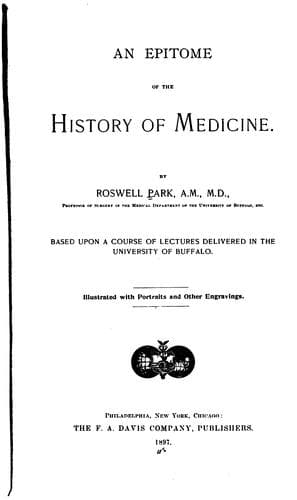
An Epitome of the History of MedicinePark, Roswell
History
An Epitome of the History of Medicine
Park, Roswell
Medicine -- History
A few{253} of Skoda's more eminent colleagues deserve brief mention:
Oppolzer (1808-1871) was singularly gifted in diagnosis, popular, a
teacher of wide influence, and manifested in superlative degree the
characteristics that constitute a great physician; he wrote little,
but was for a long time Professor of Medicine at Prague. Von Hebra,
the elder (1816-1880), worked a complete revolution in dermatology, and
developed a classification based upon the pathological anatomy of
the skin. He instituted a new and independent line of therapeutics as
applied to this branch of our art, for which the medical world will ever
hold him in grateful remembrance. Sigmund and Zeissel during the
same period did much to clear up the problems of syphilis. To Czermak
(1828-1873) and TUrck (1807-1868) we are indebted (practically) for the
making a specialty of diseases of the nose and larynx; of like service
to ophthalmology were Jàger, Jaxtthal, Arlt, Stellwag von Carion,
Hasner, Mauthner, Fuchs, and von Reuss, while Gruber and Politzer did as
much for diseases of the ear.
An indirect offshoot of the new Vienna school is the so-called
"Physiological Medicine," founded by Eoser (1817-1888),{254} of
Stuttgart (late Professor of Surgery in Marburg), seconded by Griesinger
and Wunderlich. Their views were directed against the symptomatologists
and idealists, and particularly against the School of Natural History,
the claim being that physiology must include vital phenomena, while from
the morbid portions of these phenomena the special science should
be formed as an artificial, yet practical, division of knowledge.
'Wunderlich's book of therapeutics was for a long time the best guide
in this direction, inasmuch as it left to individual thought and
judgment--the Hippocratic method of investigation--the determination of
value and demand. Another offshoot, that differs but little from this
save in definition, is the "School of Rational Medicine," originated by
Pfeufer (1806-1869) and Henle (1809-1855), and which, since 1841,
has been represented by a special journal. While Wunderlich claimed
pathology to be the physiology of the sick, Henle considered this
questionable and made no distinction at all between the physiology of
the healthy and that of the ill. The language of the followers of this
school contrasted strongly with that emanating from other schools, and
for a time was confident and ingeniously triumphant; nevertheless, it
did not forget philosophical speculation, and Hegel may now be regarded
as indirectly the godfather of rational medicine.
Public-domain text, read in full here on John Shaqi.
Reviews
Reviews
No reviews yet
Be the first to share your thoughts on this work.
Elsewhere in the archive
Join the Discussion
Join the discussion
Sign in to leave a comment or review.
Sign InorCreate an account