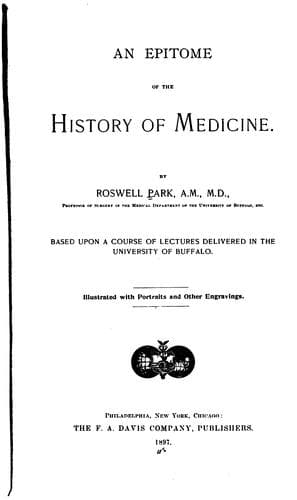
An Epitome of the History of MedicinePark, Roswell
History
An Epitome of the History of Medicine
Park, Roswell
Medicine -- History
The first truly scientific practitioner of orthopædic surgery in France
was Delpech (1777-1832). of Toulouse, who{269} was likewise the pioneer
in subcutaneous tenotomy of the tendo Achillis and in autoplastic
operations. At his own expense he erected a large orthopaedic institute
in Montpellier, and his death occurred while on his way to pay a visit
to this institution, both he and his coachman being shot by an insane
patient upon whom he had operated.
Dupuytren's successor in the Hôtel-Dieu was Roux (1780-1854), who earned
specific reputation as a dextrous and rapid operator; his labors in
constructive and plastic surgery were extraordinary. The first to
apply physical investigation to surgery was Lisfranc (1790-1847),--best
remembered, perhaps, in connection with amputation of the foot. Marjolin
(1770-1850) was a teacher of eminence, as were also Sanson (1790-1841)
and Cloquet (1790-1883), though the latter is better remembered for his
works on anatomy than for his exploits in surgery. Civialc (1792-1867)
is chiefly famous for revamping the operation of lithotrity, for, though
a lithotrite had been invented by d'Etoilles, Civiale was the first
actual operator, for which he was fiercely opposed by Larrey, Sanson,
Velpeau, and others; he lived to see his rivals confounded and
lithotrity accepted as a legitimate surgical procedure. Amussat
(1796-1856) reinvented torsion of arteries for the repression of
haemorrhage, for, although this measure had been suggested by the
ancients, it was held to be suitable only for very small vessels; he
never held a professorship, yet at his residence were gathered so-called
"conferences" that were attended by the most eminent medical men of the
time; he is specially known in connection with the operation for opening
the colon in the lumbar region. Pravaz was a surgeon of Lyons,
whose name has been perpetuated by the small syringe--the original
hypodermatic--which he devised. Vidal (1803-1856), of Cassis, made
a reputation by his work on _Surgery_, in five volumes, which was
extensively translated and reprinted throughout Europe. Jobert de
Lamballe{270} (1799-1867) rose from abject poverty to a professorship
and a seat in the Académie; he is particularly remembered for his
achievements in plastic operations. Velpeau (1795-1868) in 1834 became
the successor of Boyer; popular as a teacher, and an author of great
fertility, he devoted attention alike to surgery and midwifery; his
_Operative Surgery_, in three volumes, and a treatise on _Diseases of
the Mammary Gland_ are still classics. Gerdy (1797-1856), like Velpeau,
was the son of poverty-stricken parents; in 1833 he became a professor,
and wrote extensively on bandages, dressings, and on operation for the
radical cure of hernia. Bonnet (1802-1858) rendered great service
to surgery by his researches upon diseases of the joints. Malgaigne
(1806-1865), made Professor of Operative Surgery in Paris in 1865,
Public-domain text, read in full here on John Shaqi.
Reviews
Reviews
No reviews yet
Be the first to share your thoughts on this work.
Elsewhere in the archive
Join the Discussion
Join the discussion
Sign in to leave a comment or review.
Sign InorCreate an account