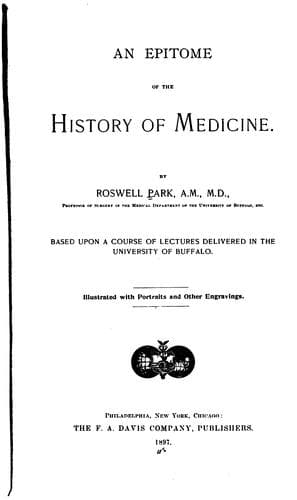
An Epitome of the History of MedicinePark, Roswell
History
An Epitome of the History of Medicine
Park, Roswell
Medicine -- History
From the earliest times physicians and writers occupied themselves
largely with obstetrics, as was most natural. The Hippocratic collection
includes monographs on _Generation; the Nature of the Infant;
the Seventh Month of Pregnancy; the Eighth Month of Pregnancy; on
Accouchement; Superfoetation; on Dentition; on Diseases of Women; on
Extraction of the Dead Foetus_. The treatise on superfcetation concerned
itself mainly with obstetrics.
On epidemics Hippocrates writes extensively, showing that he had
studied them carefully. He was among the first to connect meteorological
phenomena with those of disease during given seasons of the year,
expressing the hope that by the study of storms it would be possible to
foresee the advent of the latter, and prepare for them. Seven books of
the Hippocratic collection bear the title of _Epidemics_, although only
two of them are exclusively devoted to this subject. In these books were
contained a long{024} list of clinical observations relating to various
diseases. They constituted really a clinical study of disease.
The collection of Hippocrates's _Aphorisms_ fills seven of the books;
no medical work of antiquity can compare with these. Physicians
and philosophers of many centuries have professed for them the same
veneration as the Pythagoreans manifested for their golden verses. They
were considered the crowning glory of the collection. Even within a
short time past the Faculty of Paris required aspirants for the medical
degree to insert a certain number of these in their theses, and only the
political revolution of France served to cause a discontinuance of
this custom. These aphorisms formed, says Littré, "a succession of
propositions in juxtaposition, but not united." It has always been and
always will be disadvantageous for a work to be written in that style,
since such aphorisms lose all their general significance; and that which
seems isolated in itself becomes more so when introduced into modern
science, with which it has but little practical relationship. But not so
if the mind conceive of the ideas which prevailed when these aphorisms
were written; in this light, when they seem most disjoined they are most
related to a common doctrine by which they are united, and in this view
they no longer appear as detached sentences.
Public-domain text, read in full here on John Shaqi.
Reviews
Reviews
No reviews yet
Be the first to share your thoughts on this work.
Join the Discussion
Join the discussion
Sign in to leave a comment or review.
Sign InorCreate an account