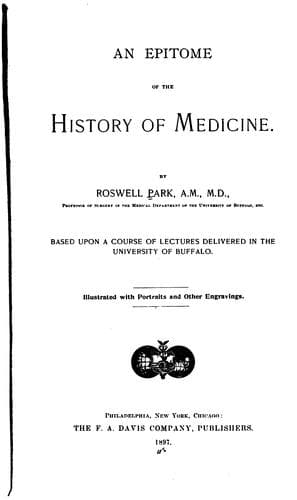
An Epitome of the History of MedicinePark, Roswell
History
An Epitome of the History of Medicine
Park, Roswell
Medicine -- History
The Hippocratic authors confounded the arteries with the veins.
Praxagoras first distinguished two kinds of vessels which he supposed
to contain air, whence the name artery. Aristotle and Erasistratus
maintained this view, which prevailed until the time of Galen, who
devoted a book to the refutation of it, basing his argument upon the
observation that always when an artery is wounded blood gushes out.
How near he came to being the discoverer of the circulation may thus be
seen. A little less reverence for authority and a little more capacity
for observation would have placed him in possession of the knowledge,
lack of which for so many centuries retarded the whole profession.
He thought the veins originated from the liver--in this respect being
behind Aristotle--but considered the heart as the common source of the
arteries and veins. Even the portal system of veins confused him, and he
erroneously described a superior and inferior aorta, but atoned for
this by describing the umbilical veins and arteries. Aristotle also had
supposed all the nerves originated from the heart, but Galen stated that
they are derived from the brain and spinal marrow, and pointed out two
kinds of nerves: those of sensation, which he thought proceeded from the
brain, and those of motion, which he considered{041} to originate in
the spinal marrow. Thus, he described distinct nerves of sensation and
motion, but sadly confused their anatomy. He seems also to have had some
notion of the great sympathetic, although it was by no means accurate.
He suggested the division of the principal nerves, in order to prove
the fact that nervous energy is transmitted from the encephalon to other
parts of the body. He speaks of glands, and thought they discharged
their secretions through veins into the various cavities, but regarded
them rather as receptacles of excrementitious matter than as agents for
secretion of valuable fluids. He even regarded the mammæ as glandular
bodies in this sense, although he knew, of course, the value of their
secretion. To Galen we owe the division of the body into cranial,
thoracic, and abdominal cavities, whose proper viscera and envelopes he
described. He spoke of the heart as having the appearance of a muscle,
but differing from it. He regarded it as the source of natural heat,
and the seat of anger and of violent passions. He appreciated that
inspiration is carried on by enlargement of the thoracic cavity. He
thought that atmospheric air entered the cavity of the cranium through
the cribriform plate of the ethmoid and passed out by the same route,
carrying with it excrementitious humors from the brain, which were
discharged into the nasal fossæ. But some portion of air thus entering
remained, according to his views, and combined with the vital spirits in
the anterior ventricles of the brain, from which combination originated
the animal spirits and immediate agents of the rational soul. These
Public-domain text, read in full here on John Shaqi.
Reviews
Reviews
No reviews yet
Be the first to share your thoughts on this work.
Join the Discussion
Join the discussion
Sign in to leave a comment or review.
Sign InorCreate an account