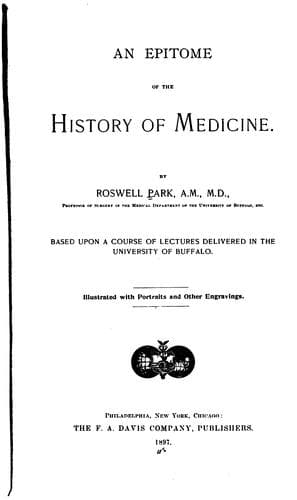
An Epitome of the History of MedicinePark, Roswell
History
An Epitome of the History of Medicine
Park, Roswell
Medicine -- History
Of the{001} origin of medicine but little need be said by way of
preface, save that it must have been nearly contemporaneous with
the origin of civilization. The lower animals when sick or wounded
instinctively lessen or alter their diet, seek seclusion and rest,
and even in certain cases seek out some particular herb or healing
substance. Thus, too, does the savage in his primitive state; and
experience and superstition together have led nearly all the savage
tribes into certain habits and forms in case of injury or disease.
For us the history of medicine must necessarily begin with the written
history of events, and its earliest endeavors need detain us but a very
short time. Its earliest period is enveloped in profound obscurity, and
so mingled with myth and table as to be very uncertain. It embraces
an indefinite time, during which medicine was not a science, but an
undigested collection of experimental notions,--vaguely described,
disfigured by tradition, and often made inutile by superstition and
ignorance. The earliest records of probable authenticity are perhaps to
be met with in the Scriptures, from which may be gathered here and there
a fair notion of Egyptian knowledge and practice. Thus we read that
Joseph commanded his servants and physicians to embalm him, this being
about 1700 B.C.. It shows that Egypt at that time possessed a class of
men who practiced the{002} healing art, and that they also embalmed
the dead, which must have both required and furnished a crude idea
of general anatomy. We are also informed from other sources that so
superstitious were the Egyptians that they not only scoffed at, but
would stone, the embalmers, for whom they had sent, after the completion
of their task. The probably mythical being whom the Egyptians called
Thoth, whom the Greeks named Hermes and the Latins Mercury, passed
among the Egyptians as the inventor of all sciences and arts. To him are
attributed an enormous number of writings concerning all subjects. Some
have considered him as identical with Bacchus, Zoroaster, Osiris, Isis,
Serapis, Apollo, and even Shem, the son of Xoah. Others have thought
him to be a god. It is now almost certain that the books attributed to
Hermes were not the work of anyone hand or of any one age. The-last six
volumes of the forty-two composing the encyclopaedia, with which Hermes
is credited, refer to medicine, and embrace a body of doctrines fairly
complete and well arranged. Of these six, the first treats of anatomy;
the second, of diseases; the third, of instruments; the fourth, of
remedies; the fifth, of diseases of the eye; and the sixth, of diseases
of women. In completeness and arrangement it rivals, if not surpasses,
the Hippocratic collection, which it antedated by perhaps a thousand
years. The Egyptians appear at first to have exposed their sick in
public (at least, so says Strabo), so that if any of those who passed by
had been similarly attacked they might give their advice for the benefit
Public-domain text, read in full here on John Shaqi.
Reviews
Reviews
No reviews yet
Be the first to share your thoughts on this work.
Join the Discussion
Join the discussion
Sign in to leave a comment or review.
Sign InorCreate an account