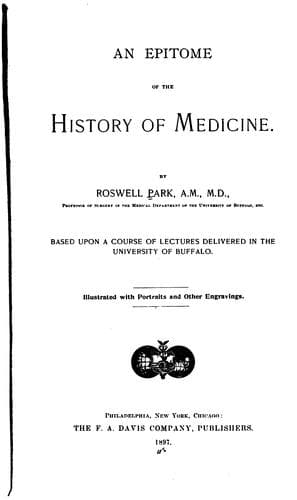
An Epitome of the History of MedicinePark, Roswell
History
An Epitome of the History of Medicine
Park, Roswell
Medicine -- History
Severino was a celebrated surgeon of Naples. He was born in 1580, in
Calabria, studied in Naples, became a doctor in Salernum, and then
became professor of anatomy in his native town. For a long time the
victim of intrigue and of persecution by the Inquisition, he was finally
driven out of Naples, but was called back by the populace. He then
became the most celebrated teacher of his time, writing extensively on a
variety of subjects. He died in 1656 of the plague, an epidemic of which
was at that time raging in central Italy.
Arriving now at the surgery of this Age, we find that matters were more
chaotic than in other departments of medicine, and for reasons which are
easily given and appreciated. While, ordinarily, external diseases are
more easily discerned than internal, and while in a corresponding degree
they can be more satisfactorily treated; while, in other words, external
pathology has ordinarily taken precedence of internal in professional
as in lay minds, this view seems to have been inverted for a time
during the Middle Ages. Previous to the period now under discussion the
sciences had generally declined in Europe, and surgery had fallen even
lower than medicine, for the reason that medicine was in the hands of
the priests, who had at that time something of a liberal education,
while the practice of surgery was abandoned to a class of ignorant
barbers, bathers, and bone-setters. No mechanic or artisan could take as
an apprentice any youth without a certificate affirming his legitimate
birth, and that he came from a family in which there were neither
barbers, bath-keepers, shepherds, nor butchers. Among the men who were
thus made social outcasts{120} were those into whose hands most of the
surgery of the fifteenth century fell. This was particularly the case
in Germany, and other European countries were little in advance. We have
seen that in France and in Italy Lanfranc and Guy de Chauliac did their
best to rescue surgery from the hands of these men, but their efforts
did not prevent it from being completely abandoned by the clergy, who
devoted themselves to the practice of medicine.
[Illustration: 0141]
Public-domain text, read in full here on John Shaqi.
Reviews
Reviews
No reviews yet
Be the first to share your thoughts on this work.
Elsewhere in the archive
Join the Discussion
Join the discussion
Sign in to leave a comment or review.
Sign InorCreate an account