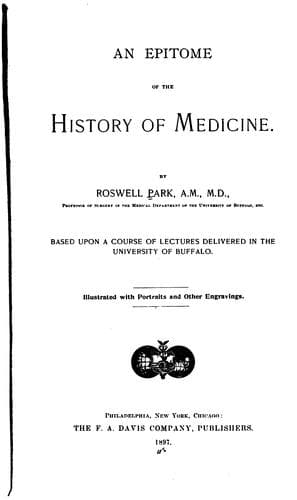
An Epitome of the History of MedicinePark, Roswell
History
An Epitome of the History of Medicine
Park, Roswell
Medicine -- History
When we come to inquire the reason for this--in other words, why an
art so useful as surgery, and one which made such requirements
for knowledge, sagacity, and dexterity, whose necessity was almost
continually felt, particularly during these troublous times of
almost constant warfare, should be so neglected by men who could best
comprehend its utility and respond to its requirements--it is difficult
to find a satisfactory answer. The social condition of the times sheds
some light upon the question. The nations of southern Europe were
socially divided at that time into the nobility, who were nearly always
at war; the clergy, who monopolized learning and filled the so-called
liberal professions; and, finally, the common people, who were common
prey for both the other classes, and who yet had to support both without
having any privileges of their own. While the practice of medicine was
a clerical right, the canon of the church prohibited physicians from
drawing blood, under pain of excommunication; and hence surgery, shunned
by the priests, to whom it naturally belonged in connection with the
practice of medicine, fell into the hands of the ignorant and vulgar,
who practiced it in a purely mechanical way, without knowledge or
appreciation of its possibilities. In addition to this, there was an
almost total lack of detailed and precise anatomical knowledge, and but
small reason to expect that the ignorant practitioners of surgery would
feel the need of such knowledge. Moreover, most of the operators were
itinerants, going from city to city, stopping so long as they had cases
to operate upon or until{122} some reverse forced them to depart. Most
of these men limited themselves to one or two sorts of operations. Some
operated for cataract, others for stone, others for hernia, nearly every
one having a secret method which was transmitted to his posterity as a
heritage.
In the history of medicine certain family names of itinerant operators
have been preserved; for example, the Branca, the Norsini, in Italy, and
the Colot in France.
Under such conditions there could be no such thing as the profession
of the surgeon. The prejudice against dissection did not begin to abate
until the thirteenth century, when a very few of the clergy dared, in
a very timid manner, to perform surgical operations. Their numbers
increased in the course of the fourteenth and fifteenth centuries, and
in the sixteenth had become considerable. Most of the great anatomists
of that period--such as Benivieni, de Carpi, Vesalius, Fallopius, and
Fabricius ab Aquapendente--were great surgeons.
Public-domain text, read in full here on John Shaqi.
Reviews
Reviews
No reviews yet
Be the first to share your thoughts on this work.
Elsewhere in the archive
Join the Discussion
Join the discussion
Sign in to leave a comment or review.
Sign InorCreate an account