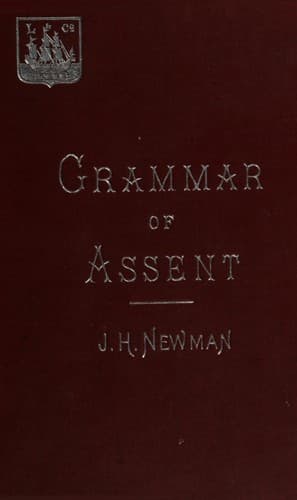
An Essay in Aid of a Grammar of Assent — John Shaqi
An Essay in Aid of a Grammar of AssentNewman, John Henry
Religion
An Essay in Aid of a Grammar of Assent
Newman, John Henry
Faith; Theism
An Essay
In Aid Of
A Grammar Of Assent.
by
John Henry Newman,
Of the Oratory.
Non in dialecticà complacuit Deo salvum facere populum suum.
ST. AMBROSE.
London:
Burns, Oates, & Co.
17 & 18, Portman Street, and 63, Paternoster Row.
1874
CONTENTS
Dedication.
Part I. Assent And Apprehension.
Chapter I. Modes Of Holding And Apprehending Propositions.
§ 1. Modes of Holding Propositions.
§ 2. Modes of apprehending Propositions.
Chapter II. Assent Considered As Apprehensive.
Chapter III. The Apprehension Of Propositions.
Chapter IV. Notional And Real Assent.
§ 1. Notional Assents.
§ 2. Real Assents.
§ 3. Notional and Real Assents Contrasted.
Chapter V. Apprehension And Assent In The Matter Of Religion.
§ 1. Belief in One God.
§ 2. Belief in the Holy Trinity.
§ 3. Belief in Dogmatic Theology.
Part II. Assent And Inference.
Chapter VI. Assent Considered As Unconditional.
§ 1. Simple Assent.
§ 2. Complex Assent.
Chapter VII. Certitude.
§ 1. Assent and Certitude Contrasted.
§ 2. Indefectibility of Certitude.
Chapter VIII. Inference.
§ 1. Formal Inference.
§ 2. Informal Inference.
§ 3. Natural Inference.
Chapter IX. The Illative Sense.
§ 1. The Sanction of the Illative Sense.
§ 2. The Nature of the Illative Sense.
§ 3. The Range of the Illative Sense.
Chapter X. Inference And Assent In The Matter Of Religion.
§ 1. Natural Religion.
§ 2. Revealed Religion.
Note.
Footnotes
DEDICATION.
To
Edward Bellasis,
Serjeant At Law,
In Remembrance
Of A Long, Equable, Sunny Friendship;
In Gratitude
For Continual Kindnesses Shown To Me,
For An Unwearied Zeal In My Behalf,
For A Trust In Me Which Has Never Wavered,
And A Prompt, Effectual Succour And Support
In Times Of Special Trial,
From His Affectionate
J. H. N.
_February 21, 1870._
PART I. ASSENT AND APPREHENSION.
Chapter I. Modes Of Holding And Apprehending Propositions.
§ 1. Modes of Holding Propositions.
1. Propositions (consisting of a subject and predicate united by the
copula) may take a categorical, conditional, or interrogative form.
(1) An interrogative, when they ask a Question, (e. g. Does Free-trade
benefit the poorer classes?) and imply the possibility of an
affirmative or negative resolution of it.
(2) A conditional, when they express a Conclusion (e. g. Free-trade
therefore benefits the poorer classes), and both imply, and imply their
dependence on, other propositions.
Public-domain text, read in full here on John Shaqi.
Reviews
Reviews
No reviews yet
Be the first to share your thoughts on this work.
Join the Discussion
Join the discussion
Sign in to leave a comment or review.
Sign InorCreate an account