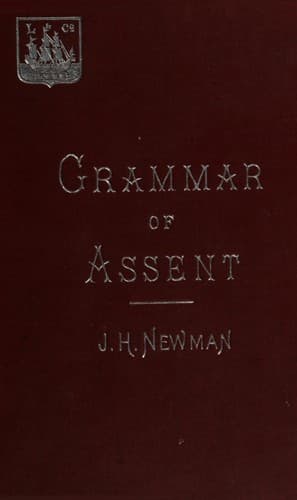
An Essay in Aid of a Grammar of AssentNewman, John Henry
Religion
An Essay in Aid of a Grammar of Assent
Newman, John Henry
Faith; Theism
I lay it down, then, as a principle that either assent is intrinsically
distinct from inference, or the sooner we get rid of the word in
philosophy the better. If it be only the echo of an inference, do not
treat it as a substantive act; but on the other hand, supposing it be
not such an idle repetition, as I am sure it is not, supposing the word
“assent” does hold a necessary place in language and in thought, if it
does not admit of being confused with concluding and inferring, if the
two words are used for two operations of the intellect which cannot
change their character, if in matter of fact they are not always found
together, if they do not vary with each other, if one is sometimes
found without the other, if one is strong when the other is weak, if
sometimes they seem even in conflict with each other, then, since we
know perfectly well what an inference is, it comes upon us to consider
what, as distinct from inference, an assent is, and we are, by the very
fact of its being distinct, advanced one step towards that account of
it which I think is the true one. The first step then towards deciding
the point, will be to inquire what the experience of human life, as it
is daily brought before us, teaches us of the relation to each other of
inference and assent.
(1.) First, we know from experience that assents may endure without
the presence of the inferential acts upon which they were originally
elicited. It is plain, that, as life goes on, we are not only inwardly
formed and changed by the accession of habits, but we are also enriched
by a great multitude of beliefs and opinions, and that on a variety
of subjects. These beliefs and opinions, held, as some of them are,
almost as first principles, are assents, and they constitute, as it
were, the clothing and furniture of the mind. I have already spoken of
them under the head of “Credence” and “Opinion.” Sometimes we are fully
conscious of them; sometimes they are implicit, or only now and then
come directly before our reflective faculty. Still they are assents;
and, when we first admitted them, we had some kind of reason, slight
or strong, recognized or not, for doing so. However, whatever those
reasons were, even if we ever realized them, we have long forgotten
them. Whether it was the authority of others, or our own observation,
or our reading, or our reflections, which became the warrant of our
assent, any how we received the matters in question into our minds as
true, and gave them a place there. We assented to them, and we still
assent, though we have forgotten what the warrant was. At present they
are self-sustained in our minds, and have been so for long years; they
are in no sense conclusions; they imply no process of thought. Here
then is a case in which assent stands out as distinct from inference.
Public-domain text, read in full here on John Shaqi.
Reviews
Reviews
No reviews yet
Be the first to share your thoughts on this work.
Elsewhere in the archive
Join the Discussion
Join the discussion
Sign in to leave a comment or review.
Sign InorCreate an account