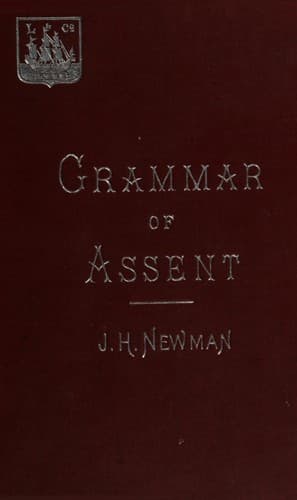
An Essay in Aid of a Grammar of AssentNewman, John Henry
Religion
An Essay in Aid of a Grammar of Assent
Newman, John Henry
Faith; Theism
(2.) Again; sometimes assent fails, while the reasons for it and the
inferential act which is the recognition of those reasons, are still
present, and in force. Our reasons may seem to us as strong as ever,
yet they do not secure our assent. Our beliefs, founded on them, were
and are not; we cannot perhaps tell when they went; we may have thought
that we still held them, till something happened to call our attention
to the state of our minds, and then we found that our assent had become
an assertion. Sometimes, of course, a cause may be found why they
went; there may have been some vague feeling that a fault lay at the
ultimate basis, or in the underlying conditions, of our reasonings; or
some misgiving that the subject-matter of them was beyond the reach
of the human mind; or a consciousness that we had gained a broader
view of things in general than when we first gave our assent; or that
there were strong objections to our first convictions, which we had
never taken into account. But this is not always so; sometimes our mind
changes so quickly, so unaccountably, so disproportionately to any
tangible arguments to which the change can be referred, and with such
abiding recognition of the force of the old arguments, as to suggest
the suspicion that moral causes, arising out of our condition, age,
company, occupations, fortunes, are at the bottom. However, what once
was assent is gone; yet the perception of the old arguments remains,
showing that inference is one thing, and assent another.
(3.) And as assent sometimes dies out without tangible reasons,
sufficient to account for its failure, so sometimes, in spite of strong
and convincing arguments, it is never given. We sometimes find men loud
in their admiration of truths which they never profess. As, by the law
of our mental constitution, obedience is quite distinct from faith,
and men may believe without practising, so is assent also independent
of our acts of inference. Again, prejudice hinders assent to the most
incontrovertible proofs. Again, it not unfrequently happens, that while
the keenness of the ratiocinative faculty enables a man to see the
ultimate result of a complicated problem in a moment, it takes years
for him to embrace it as a truth, and to recognize it as an item in the
circle of his knowledge. Yet he does at last so accept it, and then we
say that he assents.
(4.) Again; very numerous are the cases, in which good arguments,
and really good as far as they go, and confessed by us to be good,
nevertheless are not strong enough to incline our minds ever so little
to the conclusion at which they point. But why is it that we do not
assent a little, in proportion to those arguments? On the contrary, we
throw the full _onus probandi_ on the side of the conclusion, and we
refuse to assent to it at all, until we can assent to it altogether.
The proof is capable of growth; but the assent either exists or does
not exist.
Public-domain text, read in full here on John Shaqi.
Reviews
Reviews
No reviews yet
Be the first to share your thoughts on this work.
Elsewhere in the archive
Join the Discussion
Join the discussion
Sign in to leave a comment or review.
Sign InorCreate an account