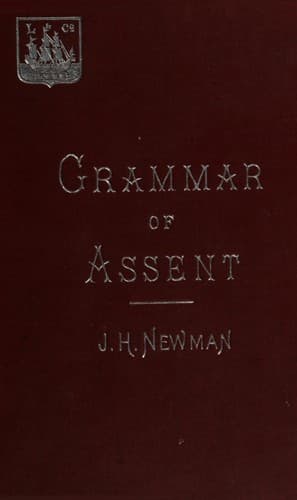
An Essay in Aid of a Grammar of AssentNewman, John Henry
Religion
An Essay in Aid of a Grammar of Assent
Newman, John Henry
Faith; Theism
My own opinion is, that the class of writers of whom I have been
speaking, have themselves as little misgiving about the truths which
they pretend to weigh out and measure, as their unsophisticated
neighbours; but they think it a duty to remind us, that since the full
etiquette of logical requirements has not been satisfied, we must
believe those truths at our peril. They warn us, that an issue which
can never come to pass in matter of fact, is nevertheless in theory a
possible supposition. They do not, for instance, intend for a moment
to imply that there is even the shadow of a doubt that Great Britain
is an island, but they think we ought to know, if we do not know, that
there is no proof of the fact, in mode and figure, equal to the proof
of a proposition of Euclid; and that in consequence they and we are all
bound to suspend our judgment about such a fact, though it be in an
infinitesimal degree, lest we should seem not to love truth for truth’s
sake. Having made their protest, they subside without scruple into
that same absolute assurance of only partially-proved truths, which is
natural to the illogical imagination of the multitude.
4. It remains to explain some conversational expressions, at first
sight favourable to that doctrine of degrees in assent, which I have
been combating.
(1.) We often speak of giving a modified and qualified, or a
presumptive and _primâ facie_ assent, or (as I have already said) a
half-assent to opinions or facts; but these expressions admit of an
easy explanation. Assent, upon the authority of others is often, as I
have noticed, when speaking of notional assents, little more than a
profession or acquiescence or inference, not a real acceptance of a
proposition. I report, for instance, that there was a serious fire in
the town in the past night; and then perhaps I add, that at least the
morning papers say so;—that is, I have perhaps no positive doubt of
the fact; still, by referring to the newspapers I imply that I do not
take on myself the responsibility of the statement. In thus qualifying
my apparent assent, I show that it was not a genuine assent at all.
In like manner a _primâ facie_ assent is an assent to an antecedent
probability of a fact, not to the fact itself; as I might give a _primâ
facie_ assent to the Plurality of worlds or to the personality of
Homer, without pledging myself to either absolutely. “Half-assent,”
of which I spoke above, is an inclination to assent, or again, an
intention of assenting, when certain difficulties are surmounted. When
we speak without thought, assent has as vague a meaning as half-assent;
but when we deliberately say, “I assent,” we signify an act of the mind
so definite, as to admit of no change but that of its ceasing to be.
Public-domain text, read in full here on John Shaqi.
Reviews
Reviews
No reviews yet
Be the first to share your thoughts on this work.
Elsewhere in the archive
Join the Discussion
Join the discussion
Sign in to leave a comment or review.
Sign InorCreate an account