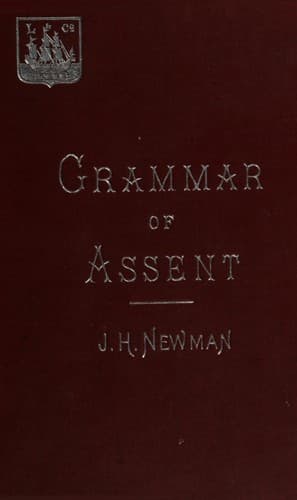
An Essay in Aid of a Grammar of AssentNewman, John Henry
Religion
An Essay in Aid of a Grammar of Assent
Newman, John Henry
Faith; Theism
(2.) And so, too, though we sometimes use the phrase “conditional
assent,” yet we only mean thereby to say that we will assent under
certain contingencies. Of course we may, if we please, include a
condition in the proposition to which our assent is given; and then,
that condition enters into the matter of the assent, but not into the
assent itself. To assent to—“If this man is in a consumption, his
days are numbered,”—is as little a conditional assent, as to assent
to—“Of this consumptive patient the days are numbered,”—which, (though
without the conditional form,) is an equivalent proposition. In such
cases, strictly speaking, the assent is given neither to antecedent
nor consequent of the conditional proposition, but to their connexion,
that is, to the enthymematic _inferentia_. If we place the condition
external to the proposition, then the assent will be given to “That
‘his days are numbered’ is conditionally true;” and of course we
can assent to the conditionality of a proposition as well as to its
probability. Or again, if so be, we may give our assent not only to
the _inferentia_ in a complex conditional proposition, but to each of
the simple propositions, of which it is made up, besides. “There will
be a storm soon, for the mercury falls;”—here, besides assenting to
the connexion of the propositions, we may assent also to “The mercury
falls,” and to “There will be a storm.” This is assenting to the
premiss, _inferentia_, and thing inferred, all at once;—we assent to
the whole syllogism, and to its component parts.
(3.) In like manner are to be explained the phrases, “deliberate
assent,” a “rational assent;” a “sudden,” “impulsive,” or “hesitating”
assent. These expressions denote, not kinds or qualities, but the
circumstances of assenting. A deliberate assent is an assent following
upon deliberation. It is sometimes called a conviction, a word which
commonly includes in its meaning two acts, both the act of inference,
and the act of assent consequent upon the inference. This subject will
be considered in the next Section. On the other hand, a hesitating
assent is an assent to which we have been slow and intermittent in
coming; or an assent which, when given, is thwarted and obscured by
external and flitting misgivings, though not such as to enter into the
act itself, or essentially to damage it.
There is another sense in which we speak of a hesitating or uncertain
assent; viz. when we assent in act, but not in the habit of our minds.
Till assent to a doctrine or fact is my habit, I am at the mercy of
inferences contrary to it; I assent to-day, and give up my belief, or
incline to disbelief, to-morrow. I may find it my duty, for instance,
after the opportunity of careful inquiry and inference, to assent to
another’s innocence, whom I have for years considered guilty; but from
long prejudice I may be unable to carry my new assent well about me,
and may every now and then relapse into momentary thoughts injurious to
him.
Public-domain text, read in full here on John Shaqi.
Reviews
Reviews
No reviews yet
Be the first to share your thoughts on this work.
Elsewhere in the archive
Join the Discussion
Join the discussion
Sign in to leave a comment or review.
Sign InorCreate an account