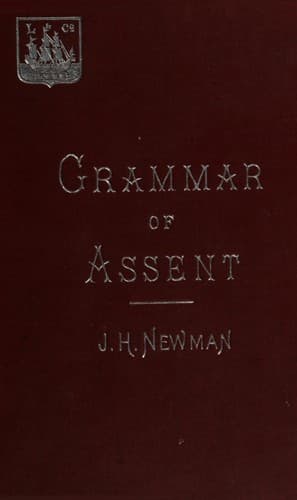
An Essay in Aid of a Grammar of AssentNewman, John Henry
Religion
An Essay in Aid of a Grammar of Assent
Newman, John Henry
Faith; Theism
I have been considering assent as the mental assertion of an
intelligible proposition, as an act of the intellect direct, absolute,
complete in itself, unconditional, arbitrary, yet not incompatible
with an appeal to argument, and at least in many cases exercised
unconsciously. On this last characteristic of assent I have not dwelt,
as it has not come in my way; nor is it more than an accident of
acts of assent, though an ordinary accident. That it is of ordinary
occurrence cannot be doubted. A great many of our assents are merely
expressions of our personal likings, tastes, principles, motives,
and opinions, as dictated by nature, or resulting from habit; in
other words, they are acts and manifestations of self: now what is
more rare than self-knowledge? In proportion then to our ignorance
of self, is our unconsciousness of those innumerable acts of assent,
which we are incessantly making. And so again in what may be almost
called the mechanical operation of our minds, in our continual acts of
apprehension and inference, speculation, and resolve, propositions pass
before us and receive our assent without our consciousness. Hence it
is that we are so apt to confuse together acts of assent and acts of
inference. Indeed, I may fairly say, that those assents which we give
with a direct knowledge of what we are doing, are few compared with the
multitude of like acts which pass through our minds in long succession
without our observing them.
That mode of assent which is exercised thus unconsciously, I may call
simple assent, and of it I have treated in the foregoing Section; but
now I am going to speak of such assents as must be made consciously and
deliberately, and which I shall call complex or reflex assents. And I
begin by recalling what I have already stated about the relation in
which Assent and Inference stand to each other,—Inference, which holds
propositions conditionally, and Assent, which unconditionally accepts
them; the relation is this:—
Public-domain text, read in full here on John Shaqi.
Reviews
Reviews
No reviews yet
Be the first to share your thoughts on this work.
Elsewhere in the archive
Join the Discussion
Join the discussion
Sign in to leave a comment or review.
Sign InorCreate an account