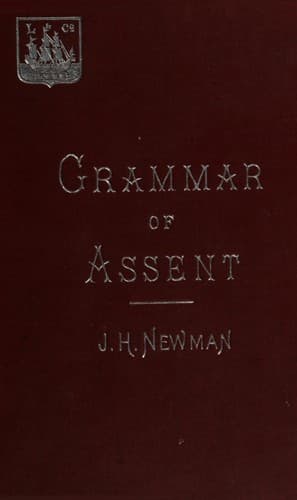
An Essay in Aid of a Grammar of AssentNewman, John Henry
Religion
An Essay in Aid of a Grammar of Assent
Newman, John Henry
Faith; Theism
Next, I consider that, in the case of educated minds, investigations
into the argumentative proof of the things to which they have given
their assent, is an obligation, or rather a necessity. Such a trial of
their intellects is a law of their nature, like the growth of childhood
into manhood, and analogous to the moral ordeal which is the instrument
of their spiritual life. The lessons of right and wrong, which are
taught them at school, are to be carried out into action amid the
good and evil of the world; and so again the intellectual assents, in
which they have in like manner been instructed from the first, have
to be tested, realized, and developed by the exercise of their mature
judgment.
Certainly, such processes of investigation, whether in religious
subjects or secular, often issue in the reversal of the assents which
they were originally intended to confirm; as the boy who works out an
arithmetical problem from his book may end in detecting, or thinking
he detects, a false print in the answer. But the question before us
is whether acts of assent and of inference are compatible; and my
vague consciousness of the possibility of a reversal of my belief in
the course of my researches, as little interferes with the honesty
and firmness of that belief while those researches proceed, as the
recognition of the possibility of my train’s oversetting is an evidence
of an intention on my part of undergoing so great a calamity. My mind
is not moved by a scientific computation of chances, nor can any law of
averages affect my particular case. To incur a risk is not to expect
reverse; and if my opinions are true, I have a right to think that
they will bear examining. Nor, on the other hand, does belief, viewed
in its idea, imply a positive resolution in the party believing never
to abandon that belief. What belief, as such, does imply is, not an
intention never to change, but the utter absence of all thought, or
expectation, or fear of changing. A spontaneous resolution never to
change is inconsistent with the idea of belief; for the very force and
absoluteness of the act of assent precludes any such resolution. We do
not commonly determine not to do what we cannot fancy ourselves ever
doing. We should readily indeed make such a formal promise if we were
called upon to do so; for, since we have the truth, and truth cannot
change, how can we possibly change in our belief, except indeed through
our own weakness or fickleness? We have no intention whatever of being
weak or fickle; so our promise is but the natural guarantee of our
sincerity. It is possible then, without disloyalty to our convictions,
to examine their grounds, even though in the event they are to fail
under the examination, for we have no suspicion of this failure.
Public-domain text, read in full here on John Shaqi.
Reviews
Reviews
No reviews yet
Be the first to share your thoughts on this work.
Elsewhere in the archive
Join the Discussion
Join the discussion
Sign in to leave a comment or review.
Sign InorCreate an account