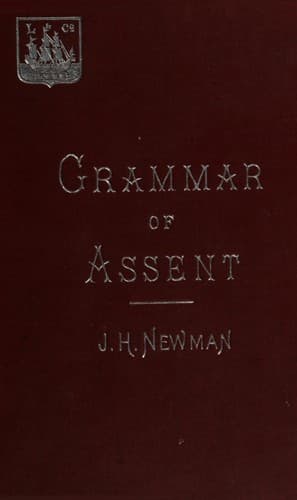
An Essay in Aid of a Grammar of AssentNewman, John Henry
Religion
An Essay in Aid of a Grammar of Assent
Newman, John Henry
Faith; Theism
We may indeed say, if we please, that a man ought not to have so
supreme a conviction in a given case, or in any case whatever; and
that he is therefore wrong in treating opinions which he does not
himself hold, with this even involuntary contempt;—certainly, we
have a right to say so, if we will; but if, in matter of fact, a man
has such a conviction, if he is sure that Ireland is to the West of
England, or that the Pope is the Vicar of Christ, nothing is left to
him, if he would be consistent, but to carry his conviction out into
this magisterial intolerance of any contrary assertion; and if he
were in his own mind tolerant, I do not say patient (for patience and
gentleness are moral duties, but I mean intellectually tolerant), of
objections as objections, he would virtually be giving countenance
to the views which those objections represented. I say I certainly
should be very intolerant of such a notion as that I shall one day
be Emperor of the French; I should think it too absurd even to be
ridiculous, and that I must be mad before I could entertain it. And
did a man try to persuade me that treachery, cruelty, or ingratitude
were as praiseworthy as honesty and temperance, and that a man who
lived the life of a knave and died the death of a brute had nothing to
fear from future retribution, I should think there was no call on me
to listen to his arguments, except with the hope of converting him,
though he called me a bigot and a coward for refusing to inquire into
his speculations. And if, in a matter in which my temporal interests
were concerned, he attempted to reconcile me to fraudulent acts by what
he called philosophical views, I should say to him, “Retro Satana,”
and that, not from any suspicion of his ability to reverse immutable
principles, but from a consciousness of my own moral changeableness,
and a fear, on that account, that I might not be intellectually true
to the truth. This, then, from the nature of the case, is a main
characteristic of certitude in any matter, to be confident indeed that
that certitude will last, but to be confident of this also, that, if it
did fail, nevertheless, the thing itself, whatever it is, of which we
are certain, will remain just as it is, true and irreversible. If this
be so, it is easy to instance cases of an adherence to propositions,
which does not fulfil the conditions of certitude; for instance:—
Public-domain text, read in full here on John Shaqi.
Reviews
Reviews
No reviews yet
Be the first to share your thoughts on this work.
Elsewhere in the archive
Join the Discussion
Join the discussion
Sign in to leave a comment or review.
Sign InorCreate an account