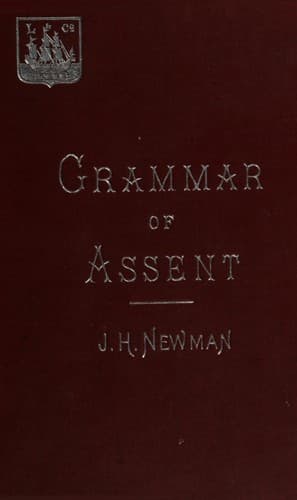
An Essay in Aid of a Grammar of AssentNewman, John Henry
Religion
An Essay in Aid of a Grammar of Assent
Newman, John Henry
Faith; Theism
(1.) Philosophers are fond of enlarging on the pleasures of Knowledge,
(that is, Knowledge as such,) nor need I here prove that such pleasures
exist; but the repose in self and in its object, as connected with
self, which I attribute to Certitude, does not attach to mere knowing,
that is, to the perception of things, but to the consciousness of
having that knowledge. The simple and direct perception of things has
its own great satisfaction; but it must recognize them as realities,
and recognize them as known, before it becomes the perception and has
the satisfaction of certitude. Indeed, as far as I see, the pleasure
of perceiving truth without reflecting on it as truth, is not very
different, except in intensity and in dignity, from the pleasure, as
such, of assent or belief given to what is not true, nay, from the
pleasure of the mere passive reception of recitals or narratives, which
neither profess to be true nor claim to be believed. Representations
of any kind are in their own nature pleasurable, whether they be true
or not, whether they come to us, or do not come, as true. We read
a history, or a biographical notice, with pleasure; and we read a
romance with pleasure; and a pleasure which is quite apart from the
question of fact or fiction. Indeed, when we would persuade young
people to read history, we tell them that it is as interesting as a
romance or a novel. The mere acquisition of new images, and those
images striking, great, various, unexpected, beautiful, with mutual
relations and bearings, as being parts of a whole, with continuity,
succession, evolution, with recurring complications and corresponding
solutions, with a crisis and a catastrophe, is highly pleasurable,
quite independently of the question whether there is any truth in them.
I am not denying that we should be baulked and disappointed to be told
they were all untrue, but this seems to arise from the reflection
that we have been taken in; not as if the fact of their truth were a
distinct element of pleasure, though it would increase the pleasure, as
investing them with a character of marvellousness, and as associating
them with known or ascertained places. But even if the pleasure of
knowledge is not thus founded on the imagination, at least it does not
consist in that triumphant repose of the mind after a struggle, which
is the characteristic of Certitude.
And so too as to such statements as gain from us a half-assent,
as superstitious tales, stories of magic, of romantic crime, of
ghosts, or such as we follow for the moment with a faint and languid
assent,—contemporary history, political occurrences, the news of the
day,—the pleasure resulting from these is that of novelty or curiosity,
and is like the pleasure arising from the excitement of chance and from
variety; it has in it no sense of possession: it is simply external to
us, and has nothing akin to the thought of a battle and a victory.
Public-domain text, read in full here on John Shaqi.
Reviews
Reviews
No reviews yet
Be the first to share your thoughts on this work.
Elsewhere in the archive
Join the Discussion
Join the discussion
Sign in to leave a comment or review.
Sign InorCreate an account