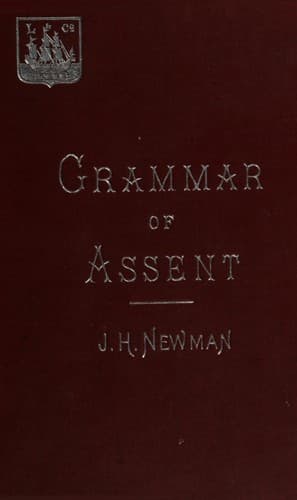
An Essay in Aid of a Grammar of AssentNewman, John Henry
Religion
An Essay in Aid of a Grammar of Assent
Newman, John Henry
Faith; Theism
(2.) Again, the Pursuit of knowledge has its own pleasure,—as distinct
from the pleasures of knowledge, as it is distinct from that of
consciously possessing it. This will be evident at once, if we consider
what a vacuity and depression of mind sometimes comes upon us on the
termination of an inquiry, however successfully terminated, compared
with the interest and spirit with which we carried it on. The pleasure
of a search, like that of a hunt, lies in the searching, and ends at
the point at which the pleasure of Certitude begins. Its elements are
altogether foreign to those which go to compose the serene satisfaction
of Certitude. First, the successive steps of discovery, which attend
on an investigation, are continual and ever-extending informations,
and pleasurable, not only as such, but also as the evidence of past
efforts, and the earnest of success at the last. Next, there is the
interest which attaches to a mystery, not yet removed, but tending to
removal,—the complex pleasure of wonder, expectation, sudden surprises,
suspense, and hope, of advances fitful, yet sure, to the unknown. And
there is the pleasure which attaches to the toil and conflict of the
strong, the consciousness and successive evidences of power, moral and
intellectual, the pride of ingenuity and skill, of industry, patience,
vigilance, and perseverance.
Such are the pleasures of investigation and discovery; and to these
we must add, what I have suggested in the last sentence, the logical
satisfaction, as it may be called, which accompanies these efforts of
mind. There is great pleasure, as is plain, at least to certain minds,
in proceeding from particular facts to principles, in generalizing,
discriminating, reducing into order and meaning the maze of phenomena
which nature presents to us. This is the kind of pleasure attendant
on the treatment of probabilities which point at conclusions without
reaching them, or of objections which must be weighed and measured,
and adjusted for what they are worth, over and against propositions
which are antecedently evident. It is the special pleasure belonging
to Inference as contrasted with Assent, a pleasure almost poetical, as
twilight has more poetry in it than noon-day. Such is the joy of the
pleader, with a good case in hand, and expecting the separate attacks
of half a dozen acute intellects, each advancing from a point of his
own. I suppose this was the pleasure which the Academics had in mind,
when they propounded that happiness lay, not in finding the truth,
but in seeking it. To seek, indeed, with the certainty of not finding
what we seek, cannot in any serious matter, be pleasurable, any more
than the labour of Sisyphus or the Danaides; but when the result does
not concern us very much, clever arguments and rival ones have the
attraction of a game of chance or skill, whether or not they lead to
any definite conclusion.
Public-domain text, read in full here on John Shaqi.
Reviews
Reviews
No reviews yet
Be the first to share your thoughts on this work.
Elsewhere in the archive
Join the Discussion
Join the discussion
Sign in to leave a comment or review.
Sign InorCreate an account