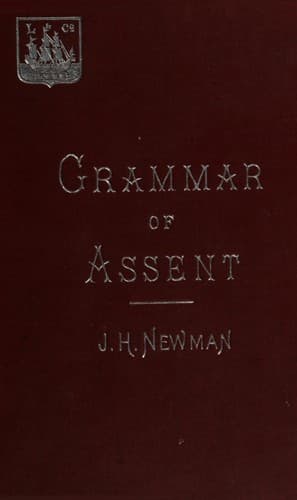
An Essay in Aid of a Grammar of AssentNewman, John Henry
Religion
An Essay in Aid of a Grammar of Assent
Newman, John Henry
Faith; Theism
(3.) Are there pleasures of Doubt, as well as of Inference and of
Assent? In one sense, there are. Not indeed, if doubt simply means
ignorance, uncertainty, or hopeless suspense; but there is a certain
grave acquiescence in ignorance, a recognition of our impotence to
solve momentous and urgent questions, which has a satisfaction of its
own. After high aspirations, after renewed endeavours, after bootless
toil, after long wanderings, after hope, effort, weariness, failure,
painfully alternating and recurring, it is an immense relief to the
exhausted mind to be able to say, “At length I know that I can know
nothing about any thing,”—that is, while it can maintain itself in a
posture of thought which has no promise of permanence, because it is
unnatural. But here the satisfaction does not lie in not knowing, but
in knowing there is nothing to know. It is a positive act of assent
or conviction, given to what in the particular case is an untruth.
It is the assent and the false certitude which are the cause of the
tranquillity of mind. Ignorance remains the evil which it ever was, but
something of the peace of Certitude is gained in knowing the worst, and
in having reconciled the mind to the endurance of it.
‐‐‐‐‐‐‐‐‐‐‐‐‐‐‐‐‐‐‐‐‐‐‐‐‐‐‐‐‐‐‐‐‐‐‐‐‐
I may seem to have been needlessly diffuse in thus dwelling on the
pleasurable affections severally attending on these various conditions
of the intellect, but I have had a purpose in doing so. That Certitude
is a natural and normal state of mind, and not (as is sometimes
objected) one of its extravagances or infirmities, is proved indeed
by the remarks which I have made above on the same objection, as
directed against Assent; for Certitude is only one of its forms. But
I have thought it well in addition to suggest, even at the expense
of a digression, that as no one would refuse to Inquiry, Doubt, and
Knowledge a legitimate place among our mental constituents, so no one
can reasonably ignore a state of mind which not only is shown to be
substantive by possessing a sentiment _sui generis_ and characteristic,
but is analogical to Inquiry, Doubt, and Knowledge, in the fact of its
thus having a sentiment of its own.
Chapter VII. Certitude.
§ 1. Assent and Certitude Contrasted.
In proceeding to compare together simple assent and complex, that
is, Assent and Certitude, I begin by observing, that popularly no
distinction is made between the two; or rather, that in religious
teaching that is called Certitude to which I have given the name of
Assent. I have no difficulty in adopting such a use of the words,
though the course of my investigation has led me to another. Perhaps
religious assent may be fitly called, to use a theological term,
“material certitude;” and the first point of comparison which I shall
make between the two states of mind, will serve to set me right with
the common way of speaking.
Public-domain text, read in full here on John Shaqi.
Reviews
Reviews
No reviews yet
Be the first to share your thoughts on this work.
Elsewhere in the archive
Join the Discussion
Join the discussion
Sign in to leave a comment or review.
Sign InorCreate an account