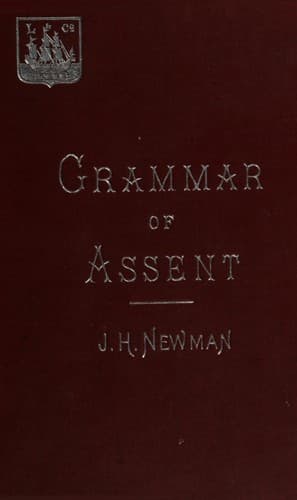
An Essay in Aid of a Grammar of AssentNewman, John Henry
Religion
An Essay in Aid of a Grammar of Assent
Newman, John Henry
Faith; Theism
Hence the poet calls memory “the mind’s eye.” I am in a foreign country
among unfamiliar sights; at will I am able to conjure up before me
the vision of my home, and all that belongs to it, its rooms and
their furniture, its books, its inmates, their countenances, looks
and movements. I see those who once were there and are no more; past
scenes, and the very expression of the features, and the tones of
the voices, of those who took part in them, in a time of trial or
difficulty. I create nothing; I see the facsimiles of facts; and of
these facsimiles the words and propositions which I use concerning them
are from habitual association the proper or the sole expression.
And so again, I may have seen a celebrated painting, or some great
pageant, or some public man; and I have on my memory stored up and
ready at hand, but latent, an impress more or less distinct of
that experience. The words “the Madonna di S. Sisto,” or “the last
Coronation,” or “the Duke of Wellington,” have power to revive that
impress of it. Memory has to do with individual things and nothing that
is not individual. And my apprehension of its notices is conveyed in a
collection of singular and real propositions.
I have hitherto been adducing instances from (for the most part)
objects of sight; but the memory preserves the impress, though not so
vivid, of the experiences which come to us through our other senses
also. The memory of a beautiful air, or the scent of a particular
flower, as far as any remembrance remains of it, is the continued
presence in our minds of a likeness of it, which its actual presence
has left there. I can bring before me the music of the _Adeste
Fideles_, as if I were actually hearing it; and the scent of a clematis
as if I were in my garden; and the flavour of a peach as if it were
in season; and the thought I have of all these is as of something
individual and from without,—as much as the things themselves, the
tune, the scent, and the flavour, are from without,—though, compared
with the things themselves, these images (as they may be called) are
faint and intermitting.
Nor need such an image be in any sense an abstraction, though I may
have eaten a hundred peaches in times past, the impression, which
remains on my memory of the flavour, may be of any of them, of the
ten, twenty, thirty units, as the case may be, not a general notion,
distinct from every one of them, and formed from all of them by a
fabrication of my mind.
Public-domain text, read in full here on John Shaqi.
Reviews
Reviews
No reviews yet
Be the first to share your thoughts on this work.
Join the Discussion
Join the discussion
Sign in to leave a comment or review.
Sign InorCreate an account