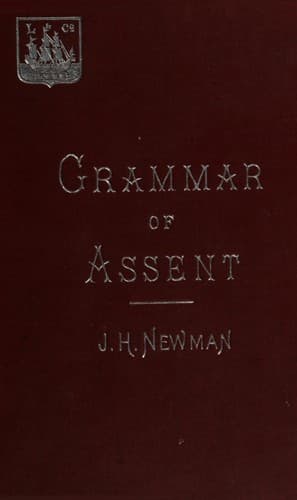
An Essay in Aid of a Grammar of AssentNewman, John Henry
Religion
An Essay in Aid of a Grammar of Assent
Newman, John Henry
Faith; Theism
I have taken an instance, in which the matter which is submitted for
examination and for assent, can hardly fail of being interesting to
the minds employed upon it; but in many cases, even though the fact
assented-to has a bearing upon action, it is not directly of a nature
to influence the feelings or conduct, except of particular persons.
And in such instances of certitude, the previous labour of coming to
a conclusion, and that repose of mind which I have above described
as attendant on an assent to its truth, often counteracts whatever
of lively sensation the fact thus concluded is in itself adapted to
excite; so that what is gained in depth and exactness of belief is
lost as regards freshness and vigour. Hence it is that literary or
scientific men, who may have investigated some difficult point of
history, philosophy, or physics, and have come to their own settled
conclusion about it, having had a perfect right to form one, are far
more disposed to be silent as to their convictions, and to let others
alone, than partisans on either side of the question, who take it up
with less thought and seriousness. And so again, in the religious
world, no one seems to look for any great devotion or fervour in
controversialists, writers on Christian Evidences, theologians, and the
like, it being taken for granted, rightly or wrongly, that such men are
too intellectual to be spiritual, and are more occupied with the truth
of doctrine than with its reality. If, on the other hand, we would see
what the force of simple assent can be, viewed apart from its reflex
confirmation, we have but to look at the generous and uncalculating
energy of faith as exemplified in the primitive Martyrs, in the youths
who defied the pagan tyrant, or the maidens who were silent under his
tortures. It is assent, pure and simple, which is the motive cause of
great achievements; it is a confidence, growing out of instincts rather
than arguments, stayed upon a vivid apprehension, and animated by a
transcendent logic, more concentrated in will and in deed for the very
reason that it has not been subjected to any intellectual development.
It must be borne in mind, that, in thus speaking, I am contrasting with
each other the simple and the reflex assent, which together make up
the complex act of certitude. In its complete exhibition keenness in
believing is united with repose and persistence.
Public-domain text, read in full here on John Shaqi.
Reviews
Reviews
No reviews yet
Be the first to share your thoughts on this work.
Elsewhere in the archive
Join the Discussion
Join the discussion
Sign in to leave a comment or review.
Sign InorCreate an account