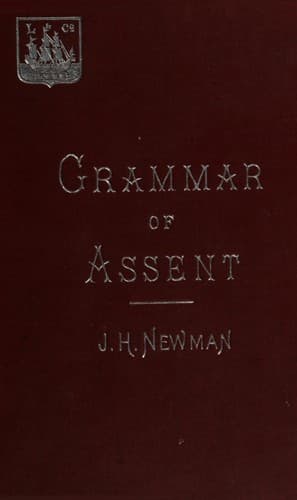
An Essay in Aid of a Grammar of AssentNewman, John Henry
Religion
An Essay in Aid of a Grammar of Assent
Newman, John Henry
Faith; Theism
The occasion of this intellectual waywardness may be slighter still.
I gaze on the Palatine Hill, or on the Parthenon, or on the Pyramids,
which I have read of from a boy, or upon the matter-of-fact reality of
the sacred places in the Holy Land, and I have to force my imagination
to follow the guidance of sight and of reason. It is to me so strange
that a lifelong belief should be changed into sight, and things should
be so near me, which hitherto had been visions. And so in times,
first of suspense, then of joy; “When the Lord turned the captivity
of Sion, then” (according to the Hebrew text) “we were like unto them
that dream.” Yet it was a dream which they were certain was a truth,
while they seemed to doubt it. So, too, was it in some sense with the
Apostles after our Lord’s resurrection.
Such vague thoughts, haunting or evanescent, are in no sense akin to
that struggle between faith and unbelief, which made the poor father
cry out, “I believe, help Thou mine unbelief!” Nay, even what in some
minds seems like an undercurrent of scepticism, or a faith founded on
a perilous substratum of doubt, need not be more than a temptation,
though robbing Certitude of its normal peacefulness. In such a case,
faith may still express the steady conviction of the intellect; it may
still be the grave, deep, calm, prudent assurance of mature experience,
though it is not the ready and impetuous assent of the young, the
generous, or the unreflecting.
4. There is another characteristic of Certitude, in contrast with
Assent, which it is important to insist upon, and that is, its
persistence. Assents may and do change; certitudes endure. This is
why religion demands more than an assent to its truth; it requires a
certitude, or at least an assent which is convertible into certitude
on demand. Without certitude in religious faith there may be much
decency of profession and of observance, but there can be no habit of
prayer, no directness of devotion, no intercourse with the unseen,
no generosity of self-sacrifice. Certitude then is essential to the
Christian; and if he is to persevere to the end, his certitude must
include in it a principle of persistence. This it has; as I shall
explain in the next Section.
§ 2. Indefectibility of Certitude.
Public-domain text, read in full here on John Shaqi.
Reviews
Reviews
No reviews yet
Be the first to share your thoughts on this work.
Elsewhere in the archive
Join the Discussion
Join the discussion
Sign in to leave a comment or review.
Sign InorCreate an account