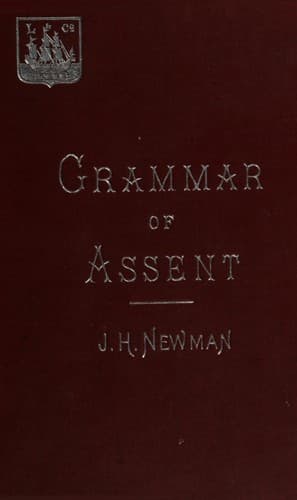
An Essay in Aid of a Grammar of AssentNewman, John Henry
Religion
An Essay in Aid of a Grammar of Assent
Newman, John Henry
Faith; Theism
To this issue indeed we may bring the main difference, viewed
philosophically, between nominal Christianity on the one hand, and
vital Christianity on the other. Rational, sensible men, as they
consider themselves, men who do not comprehend the very notion of
loving God above all things, are content with such a measure of
probability for the truths of religion, as serves them in their secular
transactions; but those who are deliberately staking their all upon the
hopes of the next world, think it reasonable, and find it necessary,
before starting on their new course, to have some points, clear and
immutable, to start from; otherwise, they will not start at all. They
ask, as a preliminary condition, to have the ground sure under their
feet; they look for more than human reasonings and inferences, for
nothing less than the “strong consolation,” as the Apostle speaks, of
those “immutable things in which it is impossible for God to lie,” His
counsel and His oath. Christian earnestness may be ruled by the world
to be a perverseness or a delusion; but, as long as it exists, it will
presuppose certitude as the very life which is to animate it.
This is the true parallel between human and divine knowledge; each of
them opens into a large field of mere opinion, but in both the one and
the other the primary principles, the general, fundamental, cardinal
truths are immutable. In human matters we are guided by probabilities,
but, I repeat, they are probabilities founded on certainties. It is
on no probability that we are constantly receiving the informations
and dictates of sense and memory, of our intellectual instincts, of
the moral sense, and of the logical faculty. It is on no probability
that we receive the generalizations of science, and the great outlines
of history. These are certain truths; and from them each of us forms
his own judgments and directs his own course, according to the
probabilities which they suggest to him, as the navigator applies his
observations and his charts for the determination of his course. Such
is the main view to be taken of the separate provinces of probability
and certainty in matters of this world; and so, as regards the world
invisible and future, we have a direct and conscious knowledge of our
Maker, His attributes, His providences, acts, works, and will; and,
beyond this knowledge lies the large domain of theology, metaphysics,
and ethics, on which it is not allowed to us to advance beyond
probabilities, or to attain to more than an opinion.
Such on the whole is the analogy between our knowledge of matters of
this world and matters of the world unseen;—indefectible certitude in
primary truths, manifold variations of opinion in their application and
disposition.
5.
Public-domain text, read in full here on John Shaqi.
Reviews
Reviews
No reviews yet
Be the first to share your thoughts on this work.
Elsewhere in the archive
Join the Discussion
Join the discussion
Sign in to leave a comment or review.
Sign InorCreate an account