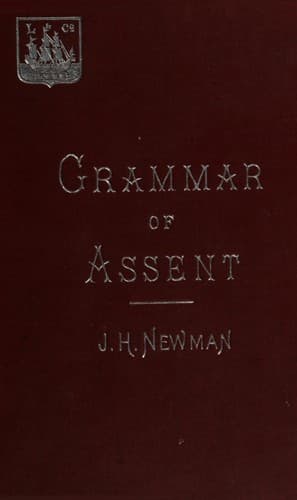
An Essay in Aid of a Grammar of AssentNewman, John Henry
Religion
An Essay in Aid of a Grammar of Assent
Newman, John Henry
Faith; Theism
I have said that Certitude, whether in human or divine knowledge, is
attainable as regards general and cardinal truths; and that in neither
department of knowledge, on the whole, is certitude discredited, lost,
or reversed; for, in matter of fact, whether in human or divine, those
primary truths have ever kept their place from the time when they first
took possession of it. However, there is one obvious objection which
may be made to this representation, and I proceed to take notice of it.
It may be urged then, that time was when the primary truths of science
were unknown, and when in consequence various theories were held,
contrary to each other. The first element of all things was said to
be water, to be air, to be fire; the framework of the universe was
eternal; or it was the ever-new combination of innumerable atoms: the
planets were fixed in solid crystal revolving spheres; or they moved
round the earth in epicycles mounted upon circular orbits; or they were
carried whirling round about the sun, while the sun was whirling round
the earth. About such doctrines there was no certitude, no more than
there is now certitude about the origin of languages, the age of man,
or the evolution of species, considered as philosophical questions. Now
theology is at present in the very same state in which natural science
was five hundred years ago; and this is the proof of it,—that, instead
of there being one received theological science in the world, there
are a multitude of hypotheses. We have a professed science of Atheism,
another of Deism, a Pantheistic, ever so many Christian theologies, to
say nothing of Judaism, Islamism, and the Oriental religions. Each of
these creeds has its own upholders, and these upholders all certain
that it is the very and the only truth, and these same upholders, it
may happen, presently giving it up, and then taking up some other
creed, and being certain again, as they profess, that it and it only is
the truth, these various so-called truths being incompatible with each
other. Are not Jews certain about their interpretation of their law?
yet they become Christians: are not Catholics certain about the new
law? yet they become Protestants. At present then, and as yet, there is
no clear certainty anywhere about religious truth at all; it has still
to be discovered; and therefore for Catholics to claim the right to
lay down the first principles of theological science in their own way,
is to assume the very matter in dispute. First let their doctrines be
universally received, and then they will have a right to place them on
a level with the certainty which belongs to the laws of motion or of
refraction. This is the objection which I propose to consider.
Public-domain text, read in full here on John Shaqi.
Reviews
Reviews
No reviews yet
Be the first to share your thoughts on this work.
Elsewhere in the archive
Join the Discussion
Join the discussion
Sign in to leave a comment or review.
Sign InorCreate an account