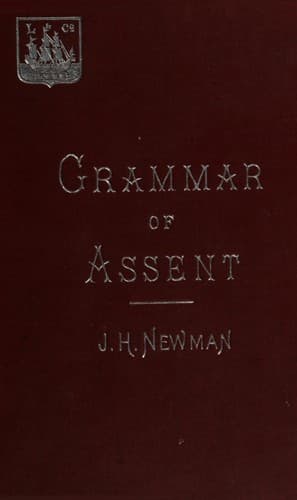
An Essay in Aid of a Grammar of AssentNewman, John Henry
Religion
An Essay in Aid of a Grammar of Assent
Newman, John Henry
Faith; Theism
The first point to be ascertained, then, when we hear of a change of
religious certitude in another, is, what the doctrines are on which his
so-called certitude before now and at present has respectively fallen.
All doctrines besides these were the accidents of his profession, and
the indefectibility of certitude would not be disproved, though he
changed them every year. There are few religions which have no points
in common; and these, whether true or false, when embraced with an
absolute conviction, are the pivots on which changes take place in
that collection of credences, opinions, prejudices, and other assents,
which make up what is called a man’s selection and adoption of a form
of religion, a denomination, or a Church. There have been Protestants
whose idea of enlightened Christianity has been a strenuous antagonism
to what they consider the unmanliness and unreasonableness of Catholic
morality, an antipathy to the precepts of patience, meekness,
forgiveness of injuries, and chastity. All this they have considered
a woman’s religion, the ornament of monks, of the sick, the feeble,
and the old. Lust, revenge, ambition, courage, pride, these, they have
fancied, made the man, and want of them the slave. No one could fairly
accuse such men of any great change of their convictions, or refer to
them in proof of the defectibility of certitude, if they were one day
found to have taken up the profession of Islam.
And if this intercommunion of religions holds good, even when the
common points between them are but errors held in common, much more
natural will be the transition from one religion to another, without
injury to existing certitudes, when the common points, the objects of
those certitudes, are truths; and still stronger in that case and more
constraining will be the sympathy, with which minds that love truth,
even when they have surrounded it with error, will yearn towards the
Catholic faith, which contains within itself, and claims as its own,
all truth that is elsewhere to be found, and more than all, and nothing
but truth. This is the secret of the influence, by which the Church
draws to herself converts from such various and conflicting religions.
They come, not to lose what they have, but to gain what they have not;
and in order that, by means of what they have, more may be given to
them. St. Augustine tells us that there is no false teaching without
an intermixture of truth; and it is by the light of those particular
truths, contained respectively in the various religions of men, and by
our certitudes about them, which are possible wherever those truths are
found, that we pick our way, slowly perhaps, but surely, into the One
Religion which God has given, taking our certitudes with us, not to
lose, but to keep them more securely, and to understand and love their
objects more perfectly.
Public-domain text, read in full here on John Shaqi.
Reviews
Reviews
No reviews yet
Be the first to share your thoughts on this work.
Elsewhere in the archive
Join the Discussion
Join the discussion
Sign in to leave a comment or review.
Sign InorCreate an account