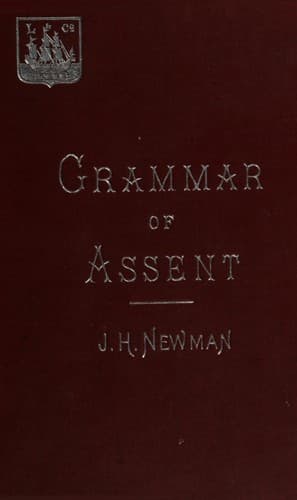
An Essay in Aid of a Grammar of AssentNewman, John Henry
Religion
An Essay in Aid of a Grammar of Assent
Newman, John Henry
Faith; Theism
Not even are idolaters and heathen out of the range of some of these
religious truths and their correlative certitudes. The old Greek and
Roman polytheists had, as they show in their literature, clear and
strong notions, nay, vivid mental images, of a Particular Providence,
of the power of prayer, of the rule of Divine Governance, of the law of
conscience, of sin and guilt, of expiation by means of sacrifices, and
of future retribution: I will even add, of the Unity and Personality
of the Supreme Being. This it is that throws such a magnificent light
over the Homeric poems, the tragic choruses, and the Odes of Pindar;
and it has its counterpart in the philosophy of Socrates and of the
Stoics, and in such historians as Herodotus. It would be out of place
to speak confidently of a state of society which has passed away,
but at first sight it does not appear why the truths which I have
enumerated should not have received as genuine and deliberate an assent
on the part of Socrates or Cleanthes, (of course with divine aids,
but they do not enter into this discussion,) as was given to them by
St. John or St. Paul, nay, an assent which rose to certitude. Much
more safely may it be pronounced of a Mahometan, that he may have a
certitude of the Divine Unity, as well as a Christian; and of a Jew,
that he may believe as truly as a Christian in the resurrection of the
body; and of a Unitarian that he can give a deliberate and real assent
to the fact of a supernatural revelation, to the Christian miracles,
to the eternal moral law, and to the immortality of the soul. And so,
again, a Protestant may, not only in words, but in mind and heart,
hold, as if he were a Catholic, with simple certitude, the doctrines
of the Holy Trinity, of the fall of man, of the need of regeneration,
of the efficacy of Divine Grace, and of the possibility and danger of
falling away. And thus it is conceivable that a man might travel in
his religious profession all the way from heathenism to Catholicity,
through Mahometanism, Judaism, Unitarianism, Protestantism, and
Anglicanism, without any one certitude lost, but with a continual
accumulation of truths, which claimed from him and elicited in his
intellect fresh and fresh certitudes.
Public-domain text, read in full here on John Shaqi.
Reviews
Reviews
No reviews yet
Be the first to share your thoughts on this work.
Elsewhere in the archive
Join the Discussion
Join the discussion
Sign in to leave a comment or review.
Sign InorCreate an account