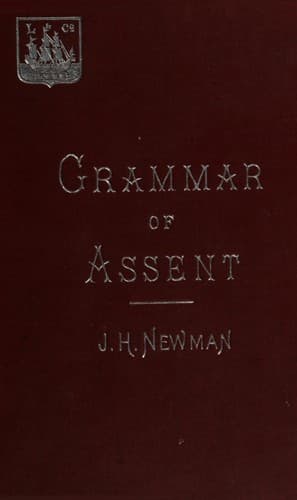
An Essay in Aid of a Grammar of AssentNewman, John Henry
Religion
An Essay in Aid of a Grammar of Assent
Newman, John Henry
Faith; Theism
Again, let us suppose, for argument’s sake, that ethnologists,
philologists, anatomists, and antiquarians agreed together in separate
demonstrations that there were half a dozen races of men, and that they
were all descended from gorillas, or chimpanzees, or ourang-outangs,
or baboons; moreover, that Adam was an historical personage, with
a well-ascertained dwelling-place, surroundings and date, in a
comparatively modern world. On the other hand, let me believe that
the Word of God Himself distinctly declares that there were no men
before Adam, that he was immediately made out of the slime of the
earth, and that he is the first father of all men that are or ever have
been. Here is a contradiction of statements more direct than in the
former instance; the two cannot stand together; one or other of them
is untrue. But whatever means I might be led to take, for making, if
possible, the antagonism tolerable, I conceive I should never give up
my certitude in that truth which on sufficient grounds I determined
to come from heaven. If I so believed, I should not pretend to argue,
or to defend myself to others; I should be patient; I should look for
better days; but I should still believe. If, indeed, I had hitherto
only half believed, if I believed with an assent short of certitude, or
with an acquiescence short of assent, or hastily or on light grounds,
then the case would be altered; but if, after full consideration, and
availing myself of my best lights, I did think that beyond all question
God spoke as I thought He did, philosophers and experimentalists might
take their course for me,—I should consider that they and I thought
and reasoned in different mediums, and that my certitude was as little
in collision with them or damaged by them, as if they attempted to
counteract in some great matter chemical action by the force of
gravity, or to weigh magnetic influence against capillary attraction.
Of course, I am putting an impossible case, for philosophical
discoveries cannot really contradict divine revelation.
So much on the indefectibility of certitude; as to the question whether
any other assent is indefectible besides it, I think prejudice may
be such; but it cannot be confused with certitude, for the one is an
assent previous to rational grounds, and the other an assent given
expressly after careful examination.
It seems then that on the whole there are three conditions of
certitude: that it follows on investigation and proof, that it is
accompanied by a specific sense of intellectual satisfaction and
repose, and that it is irreversible. If the assent is made without
rational grounds, it is a rash judgment, a fancy, or a prejudice; if
without the sense of finality, it is scarcely more than an inference;
if without permanence, it is a mere conviction.
Chapter VIII. Inference.
§ 1. Formal Inference.
Public-domain text, read in full here on John Shaqi.
Reviews
Reviews
No reviews yet
Be the first to share your thoughts on this work.
Elsewhere in the archive
Join the Discussion
Join the discussion
Sign in to leave a comment or review.
Sign InorCreate an account