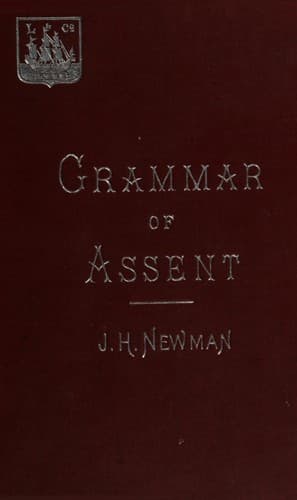
An Essay in Aid of a Grammar of AssentNewman, John Henry
Religion
An Essay in Aid of a Grammar of Assent
Newman, John Henry
Faith; Theism
Inference is the conditional acceptance of a proposition, Assent is
the unconditional; the object of Assent is a truth, the object of
Inference is the truth-like or a verisimilitude. The problem which I
have undertaken is that of ascertaining how it comes to pass that a
conditional act leads to an unconditional; and, having now shown that
assent really is unconditional, I proceed to show how inferential
exercises, as such, always must be conditional.
We reason, when we hold this by virtue of that; whether we hold it as
evident or as approximating or tending to be evident, in either case we
so hold it because of holding something else to be evident or tending
to be evident. In the next place, our reasoning ordinarily presents
itself to our mind as a simple act, not a process or series of acts.
We apprehend the antecedent and then apprehend the consequent, without
explicit recognition of the medium connecting the two, as if by a sort
of direct association of the first thought with the second. We proceed
by a sort of instinctive perception, from premiss to conclusion. I call
it instinctive, not as if the faculty were one and the same to all
men in strength and quality (as we generally conceive of instinct),
but because ordinarily, or at least often, it acts by a spontaneous
impulse, as prompt and inevitable as the exercise of sense and memory.
We perceive external objects, and we remember past events, without
knowing how we do so; and in like manner we reason without effort and
intention, or any necessary consciousness of the path which the mind
takes in passing from antecedent to conclusion.
Public-domain text, read in full here on John Shaqi.
Reviews
Reviews
No reviews yet
Be the first to share your thoughts on this work.
Elsewhere in the archive
Join the Discussion
Join the discussion
Sign in to leave a comment or review.
Sign InorCreate an account