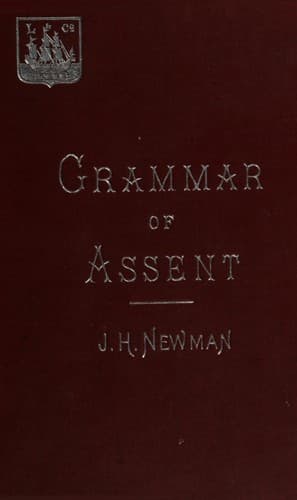
An Essay in Aid of a Grammar of AssentNewman, John Henry
Religion
An Essay in Aid of a Grammar of Assent
Newman, John Henry
Faith; Theism
Such are the characteristics of reasoning, viewed as a science or
scientific art, or inferential process, and we might anticipate that,
narrow as by necessity is its field of view, for that reason its
pretensions to be demonstrative were incontrovertible. In a certain
sense they really are so; while we talk logic, we are unanswerable;
but then, on the other hand, this universal living scene of things is
after all as little a logical world as it is a poetical; and, as it
cannot without violence be exalted into poetical perfection, neither
can it be attenuated into a logical formula. Abstract can only conduct
to abstract; but we have need to attain by our reasonings to what
is concrete; and the margin between the abstract conclusions of the
science, and the concrete facts which we wish to ascertain, will be
found to reduce the force of the inferential method from demonstration
to the mere determination of the probable. Thus, whereas (as I have
already said) Inference starts with conditions, as starting with
premisses, here are two reasons why, when employed upon matters of
fact, it can only conclude probabilities: first, because its premisses
are assumed, not proved; and secondly, because its conclusions are
abstract, and not concrete. I will now consider these two points
separately.
1.
Inference comes short of proof in concrete matters, because it has
not a full command over the objects to which it relates, but merely
assumes its premisses. In order to complete the proof, we are thrown
upon some previous syllogism or syllogisms, in which the assumptions
may be proved; and then, still farther back, we are thrown upon others
again, to prove the new assumptions of that second order of syllogisms.
Where is this process to stop? especially since it must run upon
separated, divergent, and multiplied lines of argument, the farther
the investigation is carried back. At length a score of propositions
present themselves, all to be proved by propositions more evident than
themselves, in order to enable them respectively to become premisses to
that series of inferences which terminates in the conclusion which we
originally drew. But even now the difficulty is not at an end; it would
be something to arrive at length at premisses which are undeniable,
however long we might be in arriving at them; but in this case the long
retrospection lodges us at length at what are called first principles,
the recondite sources of all knowledge, as to which logic provides
no common measure of minds,—which are accepted by some, rejected by
others,—in which, and not in the syllogistic exhibitions, lies the
whole problem of attaining to truth,—and which are called self-evident
by their respective advocates because they are evident in no other way.
One of the two uses contemplated in reasoning by rule, or in verbal
argumentation, was, as I have said, to establish a standard of truth
and to supersede the _ipse dixit_ of authority: how does it fulfil this
Public-domain text, read in full here on John Shaqi.
Reviews
Reviews
No reviews yet
Be the first to share your thoughts on this work.
Elsewhere in the archive
Join the Discussion
Join the discussion
Sign in to leave a comment or review.
Sign InorCreate an account